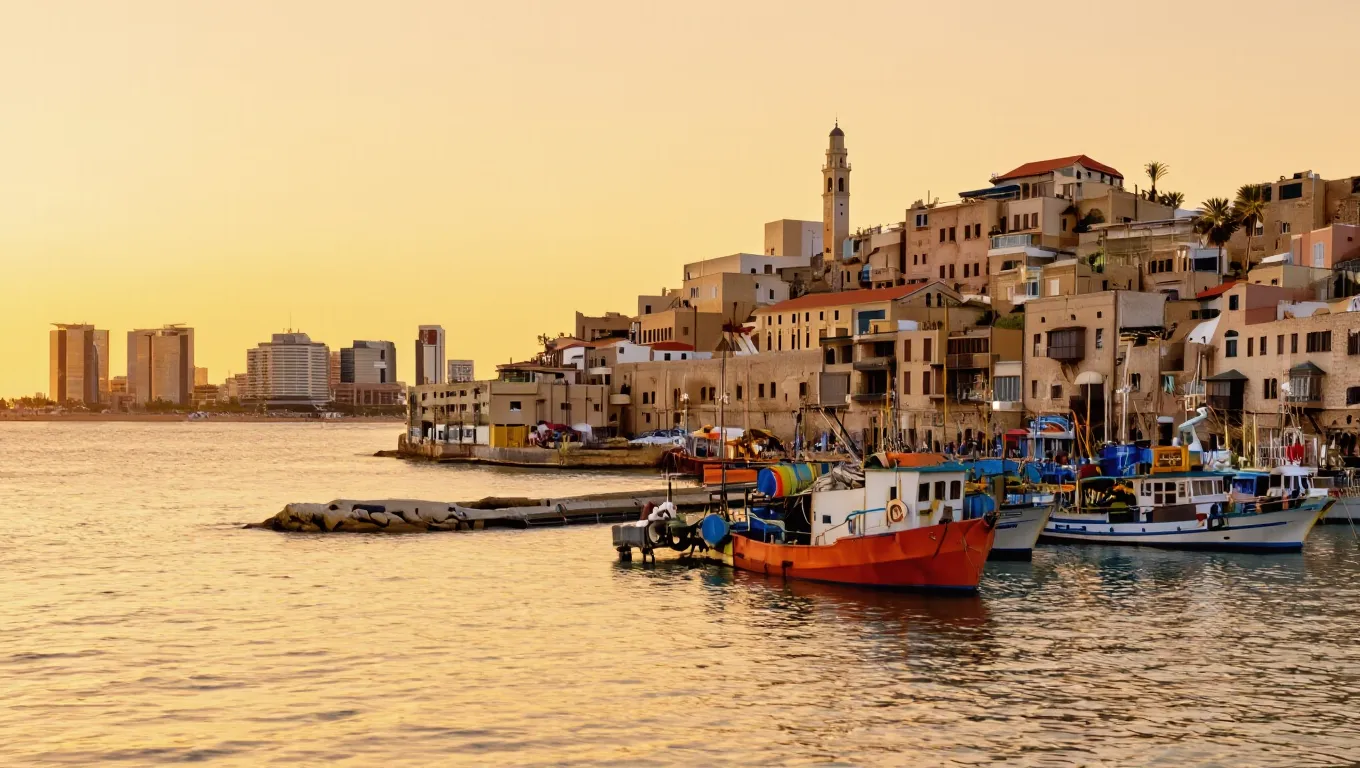
Tel Aviv’s Old Jaffa district contains two significant New Testament sites — the port where Jonah departed for Tarshish (Jonah 1:3) and the house of Simon the Tanner where Peter received the vision opening the gospel to Gentiles (Acts 10:9-16) — making it a legitimate pilgrimage stop, not just a transit hub.
Most pilgrimage itineraries treat Tel Aviv as a logistical fact: you land at Ben Gurion, you get on a bus to Jerusalem, and if you’re lucky you get one free day at the end before your flight home. That’s a shame, because one of the most important New Testament sites in the country is sitting right there at the southern edge of the city, and the rest of Tel Aviv is worth your time even if you’re not chasing biblical references.
This Tel Aviv guide for Christian visitors assumes you’ve already been to Jerusalem and the Galilee, you’re staying near the coast, and you want to know what to actually do with the hours you have. For the broader picture of Israeli food, markets, and culture, the Israel travel guide for Christian visitors covers all of it.
Old Jaffa: start here, full stop
The city you’re standing in is only about 115 years old. Jaffa is several thousand years old. The two merged into a single municipality in 1950, which means you can walk from a 1930s Bauhaus apartment block to a Bronze Age port in about twenty minutes.
Jaffa is the ancient city of Joppa, and if you’ve read the Bible with any attention you’ve been here before in your mind. Jonah walked down to this port and boarded a ship to Tarshish to avoid going to Nineveh (Jonah 1:3). When God had other plans, the story you know followed. In the New Testament, Peter was staying in Jaffa at the house of Simon the Tanner when he had the rooftop vision: the sheet lowered from heaven, filled with animals considered unclean under Jewish law, and the voice telling him to eat. The vision changed the direction of early Christianity by making clear that the gospel was for Gentiles too (Acts 10:9-16).
A house traditionally identified as Simon the Tanner’s is still marked in the neighborhood, on a lane called Simon the Tanner Street off Yefet Street. It is not a museum or a church; it’s a private house with a small plaque. That’s part of what makes Jaffa different from the heavily managed holy sites in Jerusalem: the biblical history here is just sitting in the neighborhood, unmarked and unmonetized.
The port itself is the oldest continuously operating port in the world. Walk down to the water. The breakwater rocks, the fishing boats, the smell of salt and diesel: this is the physical place. Jonah stood somewhere nearby. Peter looked out over this water. Whatever else you do today, spend twenty minutes at the edge of the port.
The Jaffa flea market
Behind the port, going north up the hill, is HaPishpeshim, the Jaffa flea market. The main street is Olei Tzion, but the market spills into the surrounding alleyways in a grid of furniture dealers, antique shops, fabric merchants, and small restaurants.
This is not a tourist souvenir market. It’s where Tel Avivians come on weekends to buy old lamps, mid-century furniture, and things they didn’t know they needed. You’ll find silver jewelry, old maps, Ottoman-era metalwork, Israeli ceramics, and enough used vinyl to keep you occupied for an hour if you’re that kind of person.
This part of Jaffa is predominantly Arab-Israeli, and most shop owners speak Hebrew and Arabic and enough English to negotiate. Prices are not fixed; a polite offer below the asking price is expected and not rude. The market is busiest on Fridays before Shabbat and on Saturdays (when it stays open, unlike most Jewish-owned businesses in the city).
For coffee while you walk, HaKosem on the market edge has good espresso and the kind of cramped standing-room format that is purely Tel Aviv. For something more substantial, the Arab restaurants on Yefet Street serve shakshuka, hummus, and grilled meats at lunch prices that are reasonable by Israeli standards.
The galleries
The neighborhood around the flea market has become one of the more interesting gallery districts in Israel over the past fifteen years. This is partly because the architecture — old Arab houses with thick stone walls and arched doorways — makes for beautiful gallery space, and partly because the rents that got pushed out of central Tel Aviv landed here.
You don’t need to be an art person to enjoy walking this part of Jaffa. The galleries mostly keep their doors open, you’re not obligated to buy anything, and the buildings themselves are worth looking at. The Old Jaffa Artists’ Quarter, up the hill from the port near Kikar Kedumin (Clock Tower Square), has a cluster of galleries and studios. If you’re there on a weekend afternoon, some artists have their studio doors open.
Kikar Kedumin is also where the Ottoman clock tower stands, built in 1906 to mark the 25th anniversary of Sultan Abdulhamid II’s reign. It’s the most photographed thing in Jaffa that isn’t the port. Worth a photo, then keep moving.
Neve Tzedek: the original Tel Aviv
Walk north from Jaffa along the waterfront for fifteen minutes and you hit Neve Tzedek, the oldest Jewish neighborhood in the city. It was founded in 1887, before the official founding of Tel Aviv in 1909, by Jewish families who wanted to live outside the walls of Jaffa. The streets are narrow, the buildings are low, and the neighborhood has the quality of a place that knows exactly what it is and doesn’t feel any particular pressure to explain itself.
The main commercial street is Shabazi Street. It has boutiques selling Israeli fashion designers (prices are real, not tourist-facing), ceramics and housewear shops, and a handful of good cafes. Suzanna restaurant on Shabazi is a reliable lunch option: mezze, grilled fish, Israeli salads. The Suzanna crowd skews older Tel Avivians and tourists who’ve been here before, which is a reasonable endorsement.
The Rokach House at the north end of Shabazi Street is a museum in the original home of Shimon Rokach, one of Neve Tzedek’s founders. It’s small and unhurried, admission is cheap, and if you want a five-minute explanation of what this neighborhood was before it became what it is now, the staff there will give you one.
Neve Tzedek connects to the HaTachana complex, a restored Ottoman train station that now houses restaurants, boutiques, and an open square where the city occasionally does outdoor concerts. It’s a pleasant place to sit in the early evening with a coffee and watch people.
Carmel Market
The Carmel Market, known locally as Shuk HaCarmel, is Tel Aviv’s main open-air food market. It runs south from the intersection of Allenby Street and King George Street down to the edge of Neve Tzedek. A walk from one end to the other takes about ten minutes if you don’t stop for anything, which you won’t.
The front section near Allenby is the most chaotic: cheap clothing, household goods, phone cases, tourists. Push through it. The back half of the market is where the food is: produce stalls, spice merchants, cheese shops, a fishmonger, a butcher, a baker selling sesame-crusted ka’ak bread out of a cart. A bag of good za’atar costs about what it costs at the source. The dried fruit and nut selection — pistachios, Medjool dates, dried apricots, all in bins — is worth buying for the bus.
For eating at the market, the best move is Miznon on Ibn Gabirol Street at the market’s edge. It’s a pita restaurant run by Israeli chef Eyal Shani, and the pitas here are the reason people talk about Israeli street food the way they do. The roasted cauliflower in a pita, which Shani basically made famous, is not a vegetarian compromise; it’s the thing to get. The line is real; go before noon or after 2pm.
If you want to sit down near the market, the Levinsky Market on Levinsky Street (a five-minute walk east) is a smaller, spice-focused market street that also has a cluster of restaurants and wine bars around it. Almacén on Levinsky is a wine bar with a short food menu, outdoor seating, and no dress code, which is a relevant detail for a church group that has been on their feet all day.
The White City: a quick architectural detour
In the 1930s, thousands of Jewish immigrants arrived in Tel Aviv from Germany, many of them architects trained in the Bauhaus tradition. They built a city. The result is the largest collection of International Style (Bauhaus) architecture anywhere in the world, now a UNESCO World Heritage Site. The concentration is highest in a rough triangle between Rothschild Boulevard, Dizengoff Street, and Allenby Street.
This is not a biblical stop. It’s worth thirty minutes if you’re in the area, for the simple reason that the buildings are beautiful and the story of how they got there is worth knowing. The Tel Aviv municipality runs a free self-guided walking tour route on their website; the Israel Ministry of Tourism also has a White City route mapped. The walk takes about 45 minutes at a casual pace and gives you the best-preserved stretch of buildings along Rothschild Boulevard and the side streets off Dizengoff Square.
The best time to walk it is early morning or late afternoon, when the light comes in at an angle and you can actually see the texture of the buildings.
The beach: what to expect
Tel Aviv has about 14 kilometers of public beach running along the Mediterranean. If it’s hot and your group has any desire to see the sea up close, the beach is there and it’s good.
For a church group: there is no dress code enforced on public beaches, which means the beach has the full spectrum of Tel Aviv summer culture on display. This is not a problem, just something to know in advance so nobody is surprised. Modest swimwear is entirely normal and nobody will look twice.
The calmer options for a church group are the northern beaches around Hilton Beach and Gordon Beach, which tend to be less crowded than the central beaches near the hotels. Religious beaches with separate sections for men and women do exist in some cities, though not prominently in Tel Aviv proper.
The water is warm from May through October. Outside those months, the beach is still a nice place to walk and watch the sunset, even if you’re not swimming.
Shabbat logistics
Tel Aviv is the most secular city in Israel, and Shabbat (Friday sundown to Saturday night) is noticeably less disruptive here than in Jerusalem. Most restaurants stay open. Bars stay open. The beach stays open. The main things that stop: public buses, most supermarkets, and government offices. Taxis and ride-share apps (Gett and Yango are the main ones used locally) run continuously through Shabbat.
If your free day falls on a Saturday, it’s actually a good day to be in Tel Aviv: the city is unhurried, the restaurants are full of locals rather than tour groups, and the beach is at its most social. Jaffa is largely Arab-owned and stays open on Saturdays regardless.
The Carmel Market does not operate on Shabbat. If the market is a priority, make sure your free day is Thursday or Friday morning. For everything Shabbat does to the rest of the country, including Jerusalem logistics and transport, the full Shabbat guide for visitors has the details.
Getting around
Tel Aviv is more walkable than it looks on a map. Jaffa to Neve Tzedek to Carmel Market is roughly a 3-4 kilometer north-south route that you can do entirely on foot if the weather cooperates. Add the White City loop and you’re at about 6-7 kilometers total for a full day.
Taxis are available everywhere and relatively inexpensive by Western standards. Insist the driver turns on the meter; it’s the law and most drivers comply without issue. Gett operates like Uber and is often easier than flagging a cab if you’re not near a taxi stand.
From Jerusalem, Tel Aviv is about 45 minutes by train (the fastest route, leaving from Jerusalem Yitzhak Navon station) or about an hour by bus. The train is significantly more comfortable. If your tour is dropping you at the hotel the night before your flight, you likely have at least a morning in Tel Aviv without needing to organize your own transport. If you’re still working out where Tel Aviv fits in the broader trip, the 10-day Israel church itinerary shows how most tours structure the balance between Jerusalem, the Galilee, and coastal time.
Two countries in one trip
People who visit Israel on a pilgrimage often say they were surprised by Tel Aviv. The surprise is usually that it exists at all alongside Jerusalem: one city where every stone has a theological annotation, another where the main preoccupation on a Friday afternoon is finding a good table before the restaurant fills up.
Both of them are real. Jerusalem is not the whole country, and Tel Aviv is not a secular distraction from what you came to see. Spending a day here, particularly in Jaffa where Peter stood on a rooftop and understood that the world was larger than he thought, fills in something the pilgrimage sites don’t give you on their own.
For the spiritual and devotional side of the trip, the Holy Land pilgrimage guide is the right starting point. For overall trip planning, the complete guide to a church pilgrimage to Israel has the logistics.
One day in Tel Aviv. Start at the port in Jaffa. End somewhere with a view of the water. That’s enough to understand why this city is worth your time.