Archaeology confirms the 1st-century existence of Capernaum, the Pool of Siloam (excavated 2004), and a fishing economy around the Sea of Galilee matching the Gospels, while sites like the Via Dolorosa and the Garden of Gethsemane rest primarily on medieval tradition rather than archaeological evidence.
Most pilgrimage tours to Israel present tradition and archaeology as though they are the same thing. They are not, and conflating them does a disservice to both the visitor’s faith and the historical record. Tradition matters. A site venerated for 1,700 years carries real spiritual weight regardless of whether it can be verified by a trowel. But visitors deserve to know the difference.
This article ranks 10 major sites associated with Jesus by the quality of their archaeological evidence. Not by their importance to Christian faith, not by how moving they are to visit, but by what excavations have actually found and what those findings establish. Some sites hold up very well. Others rest almost entirely on medieval tradition.
For the broader site-by-site historical context, see the complete guide to biblical sites in Israel. For the itinerary question of how to visit these sites in sequence, the 10-day Israel church itinerary covers that logistics in detail.
Tier 1: Well-established by archaeology
These four sites have excavated physical evidence that directly corroborates specific Gospel accounts or confirms the historical settings the Gospels describe.
1. Capernaum
The Gospels’ claim that Jesus based his Galilean ministry in Capernaum is among the most archaeologically secure statements in the New Testament. Matthew 4:13 says he “left Nazareth and went to live in Capernaum.” Mark 1 and Luke 4 both describe him teaching in a Capernaum synagogue on the Sabbath. John 6:59 places the Bread of Life discourse in the Capernaum synagogue.
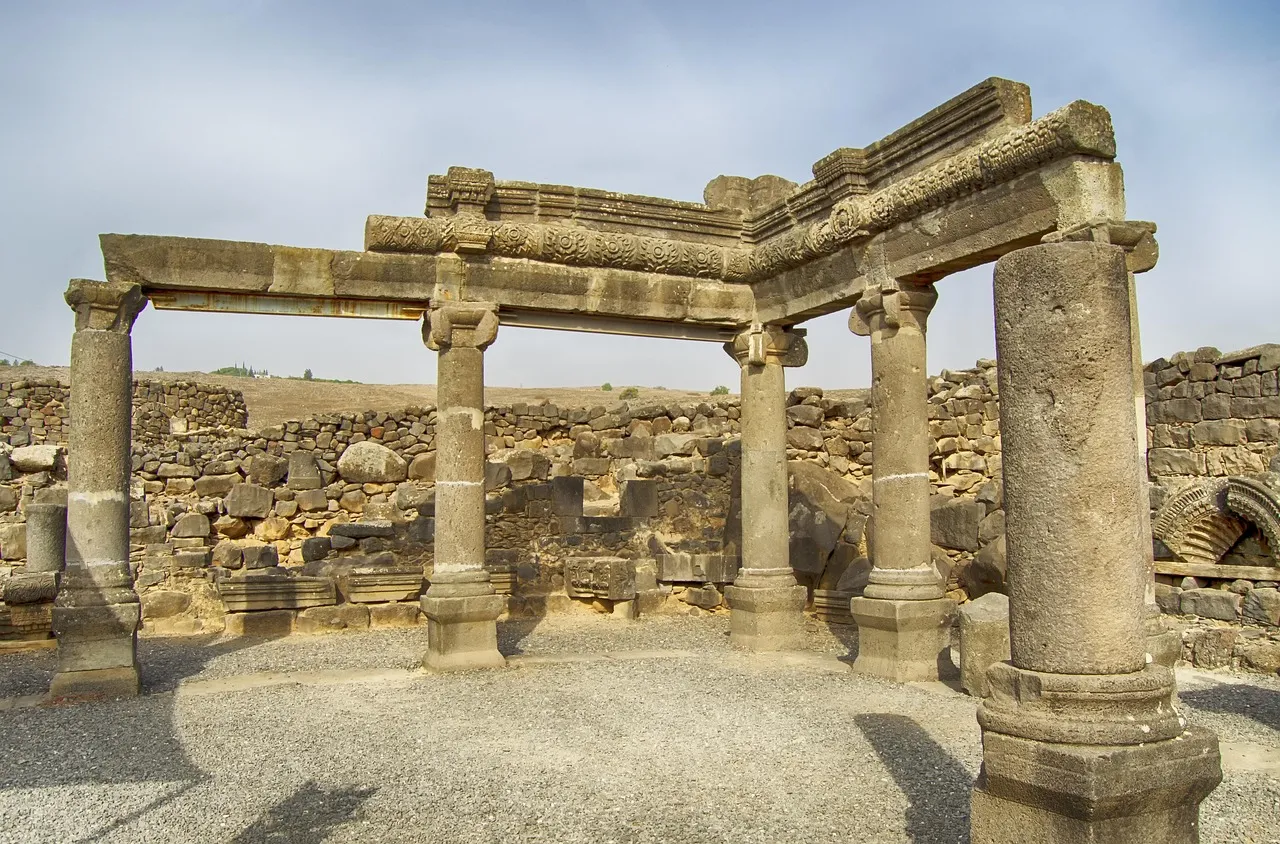
The visible limestone synagogue at the site dates to the 4th or 5th century CE, not the 1st. This caused decades of confusion. But beginning in 1969, Franciscan archaeologists Virgilio Corbo and Stanislao Loffreda excavated beneath it and found basalt-stone foundations from a 1st-century synagogue directly underneath. The later synagogue was built on top of the earlier one, which was itself built on 1st-century basalt paving. The ceramic sequence confirms continuous occupation from the 1st century BCE onward.
More significant is the “Insula Sacra,” or sacred block. Under the 5th-century octagonal church adjacent to the synagogue, Corbo and Loffreda found a 1st-century domestic dwelling whose walls had been plastered and replastered, with Christian graffiti scratched into the plaster — references to Jesus, Peter, and “Lord” in Aramaic, Greek, and Syriac dating from as early as the 2nd century CE. This is not proof that Peter lived there. It is strong evidence that early Christians, including some from the 1st and 2nd centuries, venerated this specific house as associated with him. The Pilgrim of Bordeaux noted a “house of Simon Peter” at Capernaum in 333 CE, and Egeria, visiting around 381-384 CE, recorded the same. The continuity of identification from the earliest Christian centuries is unusual and significant.
One thing most tourists at Capernaum miss: the basalt millstones scattered throughout the excavation area are not decorative. They document an actual 1st-century economy. The village produced olive oil and processed grain. The boat-builders, fishermen, tax collectors, and tradespeople that appear in the Galilean Gospel narratives are economically coherent with what archaeologists have found there.
2. The Pool of Siloam
John 9:1-11 records Jesus sending a blind man to wash in the Pool of Siloam. For most of the 20th century, pilgrims were shown a small Byzantine pool higher up the slope in the City of David as this site. In 2004, during sewer repair work in the lower part of the City of David, workers exposed stone steps. Ronny Reich and Eli Shukron of the Israel Antiquities Authority excavated the area and found a large stepped pool, roughly 70 meters wide, with coins and pottery dating firmly to the Second Temple period. The steps and construction technique match other ritual pools (miqva’ot) from the 1st century. This is the pool of John 9, not the Byzantine structure above it.
The discovery also clarified the site’s broader religious significance. Recent excavations have connected this pool via a plastered channel to the stepped street documented by Nahman Avigad and Roni Reich, which led north to the Temple Mount. Second Temple period Jews apparently walked from the Pool of Siloam up this street to the Temple — the pilgrim route. The topography of John 9 fits this context precisely.
3. Church of the Holy Sepulchre
The authenticity of this site does not rest on tradition alone, though the tradition is ancient. Constantine’s engineers in 325-326 CE identified this location as Golgotha after demolishing a Roman temple Hadrian had built there after 135 CE. The key archaeological argument is about topography.
In the 1st century, this location was outside Jerusalem’s northern walls. British archaeologist Joan Taylor’s 1998 analysis, published in “Christians and the Holy Places,” examined the geological and textual evidence and confirmed the site is consistent with a quarry and burial area at the city’s edge in the 1st century. Dan Bahat, former city archaeologist of Jerusalem, reached the same conclusion based on the distribution of Iron Age and Second Temple period tombs in the surrounding area. Jewish law required executions and burials outside the city. Golgotha and the tomb of Joseph of Arimathea, as described in the Gospels, had to be outside the city walls. This site was.
The competing identification, the Garden Tomb north of Damascus Gate, was proposed by General Charles Gordon in 1883. Gabriel Barkay examined the tomb in work published in Biblical Archaeology Review in 1986 and concluded the rock-cut chamber is consistent with Iron Age burial forms, not 1st-century Jewish practice. The Garden Tomb remains a meaningful place for many Protestant visitors. It is not a strong archaeological candidate for the 1st-century burial described in the Gospels.
What most visitors don’t notice in the Church of the Holy Sepulchre: just inside the main entrance, beneath a glass panel set into the floor, is a visible quarry face with First Temple period tomb openings cut into it. It is the most direct physical evidence that this area was outside the city and used for burial before Herod’s time.
4. Caesarea Maritima
Caesarea does not appear in the Gospels as a site Jesus visited. It is in this tier because it provides the only direct contemporary physical confirmation of the person who sentenced him to death.
In 1961, Italian archaeologist Antonio Frova’s team excavating the theater at Caesarea Maritima found a limestone block reused as a step. The inscription on it reads, in Latin: “Pontius Pilate, Prefect of Judaea, dedicated the Tiberieum to the people of Caesarea.” The stone, held today at the Israel Museum, is the only physical artifact that names Pilate. It confirms his title (Prefect, not Procurator as later sources called him), his jurisdiction, and his presence in Judea during the period the Gospels describe. This matters because Pilate was not a well-known figure in Roman imperial history. The Gospel account of a Roman prefect in Judea around 30 CE is historically plausible in every particular that can be tested.
Tier 2: Strong tradition with supporting evidence
These three sites have either consistent, ancient tradition, or archaeological confirmation of the 1st-century setting, but with meaningful gaps between what tradition claims and what excavation has documented.
5. Sea of Galilee and the fishing villages
The Synoptic Gospels place a substantial portion of Jesus’s ministry around the western and northern shore of the Sea of Galilee: the calling of the disciples (Matthew 4:18-22), the Sermon on the Mount (Matthew 5-7), healings at Bethsaida. The lake and the 1st-century fishing economy around it are among the best-documented aspects of the Gospel’s historical setting.
In 1986, a drought dropped the lake level significantly. Two brothers, Moshe and Yuval Lufan, spotted wooden timbers protruding from the northwest shoreline near Kibbutz Ginosar. Archaeologist Shelley Wachsmann of the Israel Antiquities Authority led the excavation. Carbon-14 dating and pottery analysis placed the boat’s construction between 100 BCE and 70 CE, squarely within the 1st century. The vessel is 8.2 meters long and 2.3 meters wide, consistent with the type of fishing boat described in Mark 4 and Luke 5. It is now preserved in the Yigal Allon Museum at Kibbutz Ginosar.
The boat does not prove anything about Jesus. It does prove that the Galilean fishing economy the Gospels describe was real and that vessels of exactly this type operated on the lake during the period in question. The village remains at Capernaum, Magdala, and Bethsaida document the same economy on land.
Magdala is worth noting specifically. Excavations beginning in 2009, led by the Asociacion Civil Magdala under Israeli archaeologist Dina Avshalom-Gorni, uncovered a 1st-century synagogue with a carved stone block bearing the earliest known representation of the Temple menorah. This is a site Jesus almost certainly visited, given its proximity to Capernaum and its documented importance as a Galilean fishing and trade center. Most tourists still skip it.
6. Bethlehem
The Gospels of Matthew and Luke both record Jesus’s birth in Bethlehem. The tradition connecting the Church of the Nativity to the birth site goes back at least to Justin Martyr, writing around 155 CE, and Origen, visiting around 215 CE, both of whom mention a cave at Bethlehem associated with the birth. Constantine built the original basilica over the site in 339 CE.
The honest archaeological position is that the site’s claim rests primarily on continuity of tradition rather than excavated physical evidence directly tied to a birth event. Archaeology cannot confirm where a specific person was born. What excavation can confirm is that Bethlehem was a real 1st-century village, that the cave beneath the Church of the Nativity was used in antiquity, and that the identification of this site is among the oldest and most geographically stable in Christian tradition. Amos Kloner’s survey of burial caves in the Bethlehem area documented consistent occupation through the Second Temple period.
The tradition is ancient enough and stable enough that dismissing it requires stronger counterevidence than currently exists. At the same time, the confidence with which some tour guides present the specific grotto as the definitive birthplace goes beyond what the evidence supports.
7. Nazareth
The Gospels describe Nazareth as Jesus’s hometown (Luke 2:4, 4:16; Matthew 2:23). For most of the 20th century, skeptics questioned whether Nazareth existed as a settlement in the 1st century. The matter is now settled.
In 2009, during construction work near the Church of the Annunciation, Israel Antiquities Authority archaeologist Yardenna Alexandre excavated a 1st-century domestic structure: stone-hewn walls, a courtyard, pottery and chalk vessels consistent with a Jewish household of the Second Temple period. Alexandre concluded in her 2012 publication that Nazareth was a small Jewish village in the 1st century, probably home to a few hundred people at most. This matches the Gospel’s implicit characterization of it as an unremarkable place (John 1:46: “Can anything good come from Nazareth?”).
The exact location of the house Jesus grew up in cannot be determined archaeologically, nor should anyone claim otherwise. The question that was actually in dispute — whether Nazareth existed as a Jewish village during Jesus’s lifetime — is no longer in dispute. It did.
Tier 3: Traditional identification, limited evidence
These three sites are among the most visited in Israel. Their current physical form does not date to the 1st century, and in at least one case, the traditional route likely misidentifies the actual location entirely.
8. Garden of Gethsemane
The Gospels (Matthew 26:36, Mark 14:32) name Gethsemane as the place Jesus went to pray the night of his arrest. The name means “oil press” in Aramaic, consistent with an olive grove on the Mount of Olives. The general location — the lower western slope of the Mount of Olives, across the Kidron Valley from the Temple Mount — is among the least contested identifications in the Gospel narrative. It is geographically specific, it corresponds to the topography the Gospels describe, and Eusebius in the 4th century locates it there without apparent controversy.
The question is whether the specific garden currently enclosed by the Church of All Nations is that garden. The eight large olive trees within the enclosure are the main draw for many visitors. A 2012 study by researchers at the National Research Council of Italy, using carbon-14 analysis, dated the visible trunks to approximately 900 years old, meaning they were growing during the Crusader period. The same study noted the trees showed genetic uniformity suggesting possible root-regrowth from older stock, but this is speculative. Josephus records that the Romans cut down all trees around Jerusalem during the siege of 70 CE (Jewish War 5.12.4). Trees pre-dating the 1st century cannot have survived that. Whether any of the current trees grew from roots that pre-date 70 CE is unknown.
9. Via Dolorosa
The Via Dolorosa is the most visited processional route in Christianity. It is also the identification with the largest gap between popular belief and archaeological reality.
The current 14-station route was formally established in the 16th century by Franciscans, though parts of the tradition are older. It begins at what is identified as the Antonia Fortress, the Roman military garrison adjacent to the Temple Mount, because tradition holds this is where Pilate sentenced Jesus. The Ecce Homo Arch, which pilgrims pass early in the walk, was long believed to be part of the structure from which Pilate presented Jesus to the crowd. It is actually part of a triumphal arch built by Hadrian in the 2nd century CE, documented by archaeologists including Pierre Benoit of the Ecole Biblique.
The deeper problem is that most archaeologists now place the Roman praetorium — the governor’s official residence and court — at the Herodian palace in the western part of the city, not at the Antonia. Josephus describes Herod’s palace, in the current Armenian Quarter area, as the grandest structure in Jerusalem. Roman governors typically used the grandest available structure when in Jerusalem. Shimon Gibson, in “The Final Days of Jesus” (2009), argues the trial and sentencing most likely took place at the Herodian palace. If he is correct, the Via Dolorosa begins at the wrong place.
None of this eliminates the devotional significance of walking the Via Dolorosa. Millions of Christians have found it meaningful for centuries. What it means is that you are walking a medieval pilgrimage route, not a reconstructed 1st-century path. The distinction is worth knowing.
10. The Upper Room / Cenacle
The Gospels place the Last Supper in a “large upper room” in Jerusalem (Luke 22:12, Mark 14:15). The Acts of the Apostles describes the disciples meeting in an “upper room” in Jerusalem after the resurrection (Acts 1:13). Whether these are the same room is not stated. By the 4th century, Christian tradition had identified a specific location on Mount Zion, and a church called the “Church of the Apostles” or “Hagia Zion” was associated with both the Last Supper and the events of Pentecost.
The room shown to visitors today as the Cenacle is a Crusader-era structure from the 12th century, built over earlier Byzantine remains. The Franciscans held it in the medieval period; it became a mosque under Ottoman rule; it is now administered by the Israeli government. Nothing about the current room dates to the 1st century.
Whether the underlying site preserves any physical continuity with the original “upper room” is genuinely uncertain. Bargil Pixner, a Benedictine monk and archaeologist who spent decades researching the Mount Zion area, argued in publications including “Wege des Messias” (1991) that a Jewish-Christian community maintained a presence on Mount Zion from the 1st century onward, preserving the tradition of the site. His argument is based on literary sources and indirect archaeological evidence. It is possible. It is not provable.
What this means for visitors
The evidence hierarchy above is not an argument against visiting any of these sites. It is an argument for visiting them accurately. A pilgrimage to Capernaum is a visit to a place where the physical record is entirely consistent with the Gospel account and where early Christians, within living memory of the events, identified specific structures. That is a meaningful thing to stand in front of.
A walk along the Via Dolorosa is a medieval devotional practice with deep roots in Christian piety. That is also a meaningful thing to do. It is simply a different kind of meaning.
For visitors wanting to understand the manuscript evidence alongside the site evidence — specifically how the textual transmission of the Hebrew scriptures has been verified — the article on Dead Sea Scrolls and their significance covers that ground in detail. The planning guide for church pilgrimages to Israel has more on how to structure a group visit that takes both the archaeological and devotional dimensions seriously. The spiritual pilgrimage guide addresses the faith dimension that archaeology cannot touch.
Archaeology in Israel is ongoing. The excavations at the Pool of Siloam that fundamentally changed our understanding of John 9 were completed in 2004. The Magdala synagogue stone emerged in 2009. The 1st-century house at Nazareth was found during construction work that same year. What the current evidence shows is a strong corroboration of the Gospel’s historical setting in first-century Jewish Galilee and Judea. The specific theological claims those Gospels make are not a matter of archaeology at all.