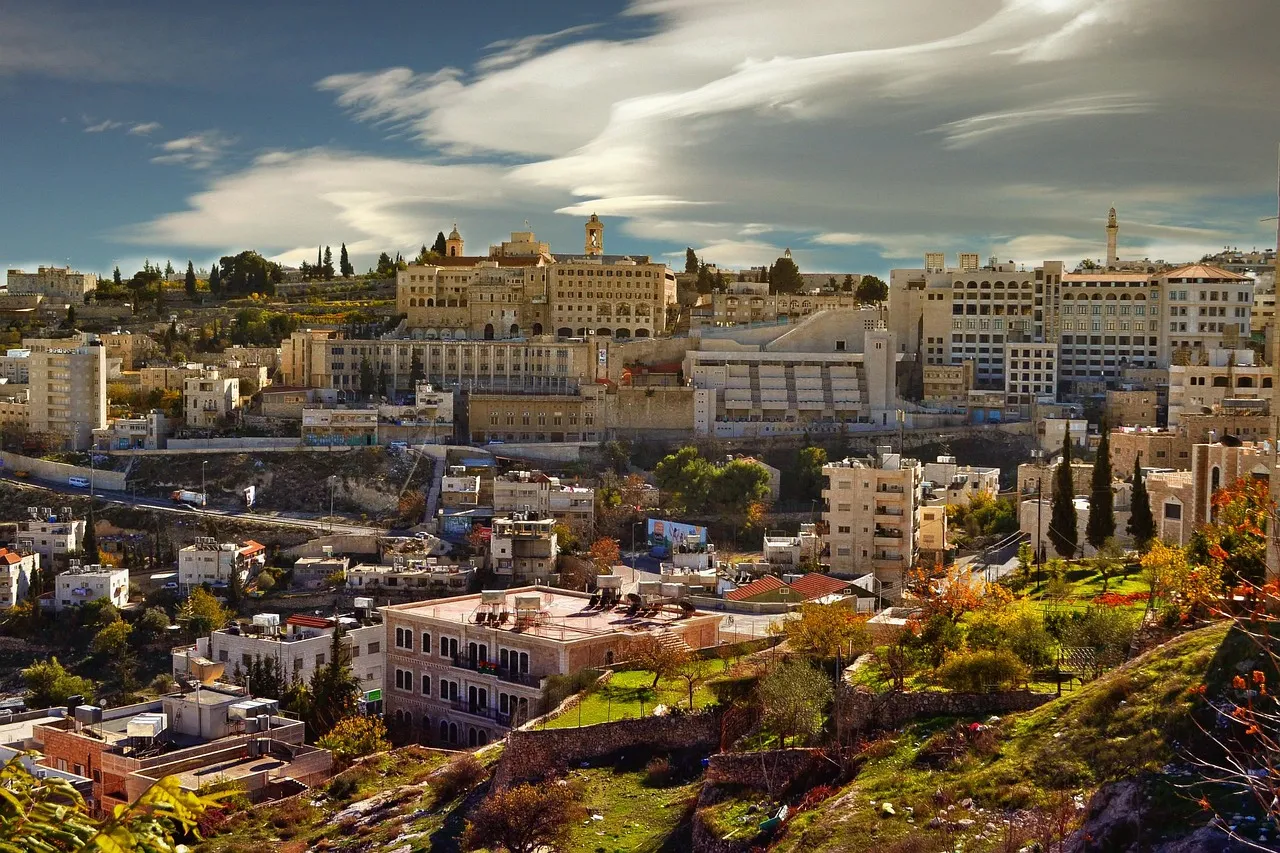
This Church of the Nativity visitor guide covers everything a pilgrim or church group needs to plan a meaningful visit: the site’s history, the Grotto of the Nativity, St. Catherine’s Church and the cave complex below it, practical logistics for getting there from Jerusalem in 2026, and the best times to visit to avoid the longest queues.
The Church of the Nativity in Bethlehem is the oldest continuously functioning church in the world. Built originally by the Roman emperor Constantine in 339 CE over a cave complex venerated since at least the 2nd century as the birthplace of Jesus, it has survived invasions, earthquakes, and the disputes of competing Christian communities. It has never been entirely destroyed and never stopped functioning as a place of worship.
UNESCO added the Church of the Nativity to its World Heritage List in 2012 — the first Palestinian site to receive the designation — specifically citing its outstanding universal value and its state of repair, which has been the subject of an ongoing restoration effort since 2013.
The Church of the Nativity: history and why it matters
Constantine’s mother Helena made a pilgrimage to the Holy Land around 326-328 CE and identified several sites for church construction. The cave in Bethlehem was among them. Construction of the first basilica was completed around 339 CE, and a mosaic floor from that original Constantinian structure survives beneath trap doors in the current nave floor. Visitors who know to look for these openings can peer down through the wooden covers to see 4th-century stonework.
The church that stands today is not Constantine’s building. It is Justinian’s. The Byzantine emperor Justinian I ordered a complete reconstruction beginning around 527 CE, enlarging the nave, adding side aisles, rebuilding the apse, and creating the structure whose basic outline you walk into now. Sixth-century mosaics on the upper walls of the nave, though damaged and incomplete, survive from this period. A visiting group of restorers in 2013, funded by a Palestinian Authority project supported by multiple European governments, documented over 50 square meters of mosaic still visible in the apse area.
Most visitors don’t know this: the church survived the Persian invasion of 614 CE largely intact. The Sassanid Persian army under Khosrow II swept through Byzantine Palestine and destroyed or damaged most Christian holy sites, including the Church of the Holy Sepulchre in Jerusalem. The Church of the Nativity was left alone. The reason, according to the 7th-century account preserved by Eutychius of Alexandria, is that the Persian commanders saw a mosaic inside the church depicting the Magi in Persian dress — the three wise men rendered in the clothing and headgear of Persian Zoroastrian priests. The soldiers declined to destroy an image that appeared to honor their own people. Whether that account is historically accurate or a convenient legend, the church did survive. The Holy Sepulchre did not.
Crusader-period additions are visible in the exterior stonework, the carved column capitals in the nave (dating to around 1169, when Armenian craftsmen under the patronage of King Amalric I added figural carvings), and the lintel fragments above the now-blocked portions of the main entrance.
The Grotto of the Nativity
The entrance to the Grotto is through stairways on either side of the main altar, descending to a cave roughly 12 meters long and 3 meters wide. The atmosphere is low-ceilinged and lit primarily by hanging oil lamps — dozens of them, donated over centuries by different Christian communities, filling the space with a persistent warm light and the faint smell of burning oil.
The focal point is a 14-pointed silver star set into the marble floor directly beneath the altar of the Nativity. The star was installed by the Roman Catholic community in 1717, removed by the Greek Orthodox in 1847 during one of the recurring disputes over custodial rights, and replaced by the Ottomans in 1853 at French diplomatic insistence. This specific dispute over the replacement of the star was one of the contributing triggers of the Crimean War. The star you see today is the 1853 replacement.
The Latin inscription around the star reads “Hic de Virgine Maria Jesus Christus natus est” — “Here Jesus Christ was born of the Virgin Mary.” Adjacent to this spot is the Chapel of the Manger, a small recess a few meters away where a marble manger marks the location where, according to tradition, the infant was placed after birth.
The Grotto is shared by three Christian communities under the terms of the Status Quo, an arrangement dating to the 18th century and formalized under Ottoman rule in 1852, which assigns specific portions of the holy sites to the Greek Orthodox, Armenian Apostolic, and Roman Catholic Churches. The arrangement is precise and occasionally contentious: each community controls certain altars, lamps, and access hours, and alterations to any element require negotiated agreement.
Queue times for the Grotto are unpredictable. On a quiet weekday the descent takes minutes; on Christmas Eve or during Easter season, the wait can exceed two hours. If your group is in Bethlehem on a tight schedule, go directly to the Grotto entrance when you arrive and queue immediately.
St. Catherine’s Church and the caves below
Adjacent to the main basilica on its northern side is St. Catherine’s Church, the Roman Catholic parish church of Bethlehem, built between 1881 and 1882 on the site of an earlier Crusader cloister. It is where the Roman Catholic Christmas midnight mass is broadcast annually.
Below St. Catherine’s is a cave complex that most visitors skip entirely. These caves include the Chapel of St. Joseph (where tradition holds that Joseph received the angel’s warning to flee to Egypt), the Chapel of the Innocents (commemorating the children killed in Herod’s massacre), and the tomb and study of Jerome.
Jerome — Eusebius Sophronius Hieronymus — lived in a cave here from approximately 386 CE until his death in 420 CE. He was a difficult man by all historical accounts, argumentative and blunt to the point of losing friendships, but his 34 years in Bethlehem produced the Latin Vulgate, the translation of the Hebrew scriptures and Greek New Testament into Latin that remained the standard biblical text of Western Christianity for over a millennium. He worked from manuscripts available to him in Bethlehem and consulted directly with Jewish scholars in the region on the Hebrew text. His tomb is in the cave complex, though his remains were later translated to the Basilica of Santa Maria Maggiore in Rome in the 13th century.
The cave where Jerome worked is a small, irregular space lit by candles. A 19th-century statue of him marks the spot traditionally identified as his desk. It is not a dramatic archaeological site. Most groups spend less than five minutes there. That is probably a mistake, given that the document produced in that cave shaped the liturgy, theology, and devotional life of Western Christianity for the next thousand years.
Practical visitor information
Bethlehem is roughly 10 kilometers south of Jerusalem, but it is in the Palestinian Authority and requires passing through Checkpoint 300 (also called the Bethlehem checkpoint). Israeli citizens cannot enter without special permission; tourists with foreign passports pass through without difficulty in most cases, though you will need to show your passport. The crossing itself takes 5 to 20 minutes when traffic is light. During pilgrimage seasons — Holy Week, Christmas — allow an additional 30 to 60 minutes.
The most straightforward route for independent travelers is a shared taxi (Arabic: “service”) from near Damascus Gate in Jerusalem’s Old City. These run frequently and cover the route in 20 to 30 minutes excluding the checkpoint. Most Jerusalem hotels can also arrange a private transfer or connect you with a licensed guide for the day, which is the better option for church groups.
The church is open daily. Hours vary by season: roughly 6:30 a.m. to 7:30 p.m. in summer and 5:30 a.m. to 5:00 p.m. in winter. The Grotto is open during the same hours but may close briefly at midday for maintenance. There is no entrance fee. Modest dress is required — shoulders and knees covered — and scarves are available at the entrance, though it is better to come prepared.
Tuesday, Wednesday, and Thursday mornings before 10 a.m. are consistently the least crowded times. Friday afternoons and Saturdays tend to be the busiest periods for domestic Christian visitors. If your group is large, coordinate with a licensed Bethlehem guide to arrange entry in smaller groups rather than all at once, which reduces bottlenecks in the Grotto stairwells.
The restoration work ongoing since 2013 has included scaffolding in sections of the nave at various points. Check the current state of the restoration before your visit — Ar-RAM Architects, the firm contracted for part of the structural work, has published progress reports that give a reasonable indication of which areas are accessible.
Manger Square, directly in front of the church, has a small visitor center and several restaurants. The Armenian Tavern and Afteem Restaurant, both within a few minutes’ walk, are the most established options for groups. Budget 90 minutes beyond your church visit if you want to explore the square and adjacent market lanes.
If your group is visiting around Christmas, the Christmas in Bethlehem pilgrim’s guide covers Midnight Mass ticketing, Shepherds’ Field at dawn, and how to plan across the three Christmas dates observed in Jerusalem. For groups building a full Holy Land itinerary that includes Bethlehem alongside Galilee, Jerusalem, and the Dead Sea, the 10-day Israel church group itinerary gives a day-by-day sequence with realistic timing at each site.