This Caesarea Maritima visitor guide covers the Roman harbor city that served as the administrative capital of Judea for six centuries — not Jerusalem. Herod the Great built it from scratch on a coastline with no natural harbor, using concrete that hardened underwater. Paul stood before Felix, Festus, and Agrippa in this city. The Pontius Pilate inscription, the only physical evidence that Pilate held the title Prefect of Judea, was found here in 1961. It is one of the most underestimated archaeological sites in Israel, and one of the most significant for Christian pilgrims working through the book of Acts.
How Herod built Caesarea: the harbor and the city
Construction began around 22 BCE and the city was dedicated in approximately 10 BCE, though ancient sources suggest some elements took longer to complete. Josephus, writing in the 1st century CE, describes the harbor at length in “Jewish Antiquities” (15.331-341) and “The Jewish War” (1.408-415). What Josephus describes is not a modest improvement to a natural inlet but the construction of a deep-water harbor on a stretch of coast that offered nothing to work with.
Herod’s engineers used pozzolana, a volcanic ash-based hydraulic concrete that the Romans had developed and that hardens when mixed with seawater. They built two enormous breakwaters extending into the sea, forming a protected basin large enough to accommodate large trading vessels. The northern breakwater was roughly 250 meters long; the southern was longer still. Robert Hohlfelder of the University of Colorado and John Oleson of the University of Victoria led underwater excavations through the Caesarea Ancient Harbour Excavation Project in the 1980s and 1990s that mapped the submerged structures and confirmed the scale of the original construction. Much of what Herod built is now underwater due to subsidence, but the core engineering is still visible to divers.
The city itself was designed on a Roman grid: paved streets, a colonnaded main street, a forum, temples, baths, and a theater. Herod built a temple to Augustus and Rome on a platform overlooking the harbor, though essentially nothing of it survives above ground. The city was planned to export agricultural products from the interior of Judea and to import Roman goods, and it functioned for that purpose throughout the Roman and Byzantine periods.
Herod named it Caesarea in honor of Augustus. He named the harbor Sebastos, the Greek equivalent of Augustus. The deference was not subtle, and it was effective: Caesarea became the kind of city that mattered to Rome.
Caesarea in the New Testament
The New Testament references to Caesarea span the full range of the city’s function as a Roman administrative center. Philip the Evangelist, one of the seven deacons appointed in Acts 6, settled in Caesarea. The city appears in Acts 8:40, after Philip baptizes the Ethiopian official on the Gaza road. Philip was still living there in Acts 21:8, when Paul and his companions stay at his house on the way to Jerusalem.
The conversion of Cornelius the centurion takes place in Caesarea (Acts 10). Cornelius is described as commanding a unit called the Italian Cohort, stationed at the city. The account of Peter traveling from biblical Joppa — modern Jaffa to Caesarea, entering the home of a Gentile, and baptizing Cornelius and his household is treated in Acts as the pivotal moment at which the early Jesus movement became explicitly cross-cultural. Most people don’t know that Acts 10 identifies Cornelius’s location with reasonable precision: Caesarea was the obvious posting for a cohort of this type, and the Italian Cohort is independently attested in inscriptions from the 1st and 2nd centuries.
Paul’s imprisonment here runs from Acts 23 through 26. He was transferred from Jerusalem after a Roman commander named Claudius Lysias uncovered an assassination plot by more than forty men who had sworn not to eat until they had killed Paul. Paul arrived in Caesarea under armed escort — 200 soldiers, 70 cavalry, and 200 spearmen, according to Acts 23:23, which is almost certainly an exaggeration but reflects genuine Roman concern about unrest. He was held in Herod’s praetorium, which archaeologists associate with the palace complex on the promontory. Governor Felix heard his case twice but left him in custody, apparently hoping for a bribe. When Festus succeeded Felix in approximately 60 CE, he reopened the case. Paul’s appeal to Caesar — the right of a Roman citizen to have a capital case heard in Rome — ended the Caesarean custody and began the voyage that occupies the last chapters of Acts.
Agrippa II and his sister Berenice attended Paul’s hearing before Festus, and Paul addressed them at length (Acts 26). Agrippa’s comment that Paul’s argument almost persuaded him is one of the more interesting lines in the book, whatever one makes of it.
The Pontius Pilate inscription
In 1961, Italian archaeologist Antonio Frova was excavating the Roman theater at Caesarea when a team member found a limestone block that had been reused as a step in a later staircase. The block was about 82 centimeters high and 68 centimeters wide. It carried an inscription in Latin, partially damaged, that read:
[DIS AUGUST]IS TIBERIEUM
[PON]TIUS PILATUS
[PRAEF]ECTUS IUDAE[AE]
[FECIT D]E[DICAVIT]
The reconstruction, widely accepted by epigraphers, reads as a dedication of a Tiberieum — a structure honoring the emperor Tiberius — by Pontius Pilatus, Prefect of Judea.
Before 1961, Pontius Pilate was known only from literary sources: the Gospels, Josephus, Philo of Alexandria, and Tacitus. None of these is a contemporary administrative document. The limestone block is. It confirms his name, his title (Prefect, not Procurator as some later sources called him), and his presence in Caesarea during the reign of Tiberius (14-37 CE), which is consistent with the dates the Gospels assign to the crucifixion.
The title matters. “Prefect” was the correct designation for the Roman governor of Judea from 6 to 41 CE. Tacitus, writing around 116 CE, used “procurator,” which was the title of the later period. The inscription uses “prefect,” which Josephus also uses for Pilate’s predecessors. A 1st-century administrative stone gets the title right where a 2nd-century historian gets it wrong.
The original inscription is in the Israel Museum in Jerusalem. A replica stands at the theater site in Caesarea. Most tour guides point it out briefly. It deserves more time than it typically gets.
What to see at Caesarea Maritima today
The main site is Caesarea National Park, which covers several distinct areas.
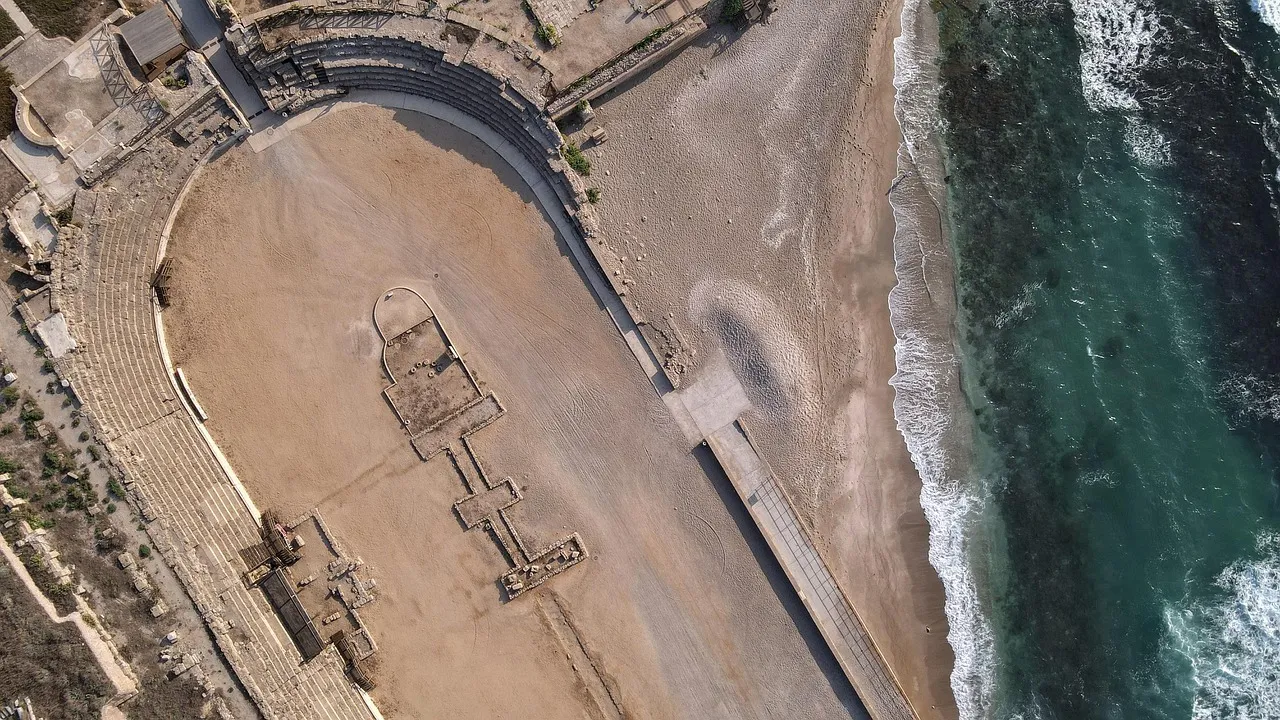
The Roman theater is the most visually complete structure. It was built by Herod and modified several times through the Roman and Byzantine periods, with a seating capacity estimated at roughly 3,500. The theater was excavated and partially reconstructed, and it now hosts live concerts and performances during summer, which creates an odd but effective juxtaposition. The vantage point from the upper tiers, looking over the stage toward the Mediterranean, is probably the most photographed view in Caesarea.
The promontory palace extends on a narrow peninsula into the sea south of the theater. This is almost certainly the structure Acts calls Herod’s praetorium, where Paul was held. The excavated remains show a large freshwater pool surrounded by colonnaded walkways — a feature that would have made the building visible from ships approaching the harbor. The pool’s presence on a coastal promontory suggests it was decorative rather than functional, which is consistent with what we know of Herod’s architectural preferences elsewhere.
The hippodrome runs inland from the theater. Herod built a chariot racing track here that was later converted into an arena. It is now partially excavated, with the outline of the track and some seating visible. Less dramatic than the theater but useful context for understanding the scale of the original city.
The Crusader city occupies the central area of the modern park. After the Arab conquest in 640 CE and a long Byzantine-to-Arab transition, Caesarea came under Crusader control in 1101. The Crusaders built a smaller walled city within the ruins of the Roman one, with a moat, towers, and a cathedral. Their fortifications are the most intact medieval remains on the Israeli coast. The cathedral was built over what had been a Roman temple precinct.
The high-level aqueduct runs for several kilometers north of the main park along the beach. Herod built a lower aqueduct to supply the city; the higher one was added by the Roman emperor Hadrian in the 2nd century, likely to serve the expanded Roman garrison. The arches are well preserved and accessible from the beach. Walking the aqueduct stretch at low tide is one of the better experiences the site offers, and most tour groups skip it.
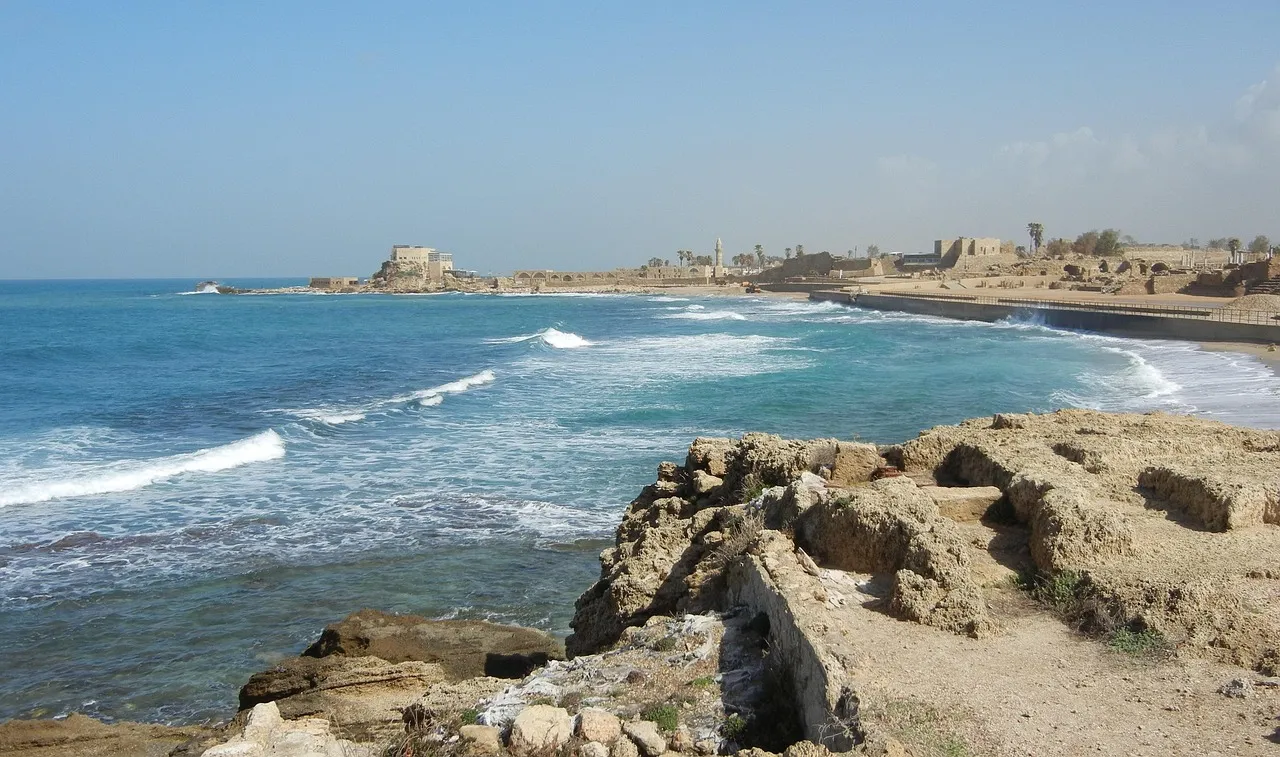
The underwater archaeology trail is not widely advertised. Snorkelers and divers can follow a marked route over the submerged harbor structures. The Israel Antiquities Authority and the Caesarea Development Corporation have maintained the trail for several years, with anchors and markers placed to protect the remains. The remains of Herod’s concrete breakwaters are visible in relatively shallow water. This is not a heavily promoted attraction but it is archaeologically significant.
Practical information
Caesarea is on the coastal highway (Highway 2) roughly halfway between Tel Aviv (50 kilometers south) and Haifa (40 kilometers north). It is the natural stopping point on any north-south itinerary between those two cities, and groups heading from Jerusalem or Tel Aviv to the Galilee region pass close to the site regardless of routing.
The national park entrance covers the theater, promontory palace, hippodrome, and Crusader city. The aqueduct beach is accessible without an entrance fee. Two hours is enough for the main park at a measured pace. Three hours covers the aqueduct walk comfortably. Groups planning the underwater trail need to arrange equipment in advance through the local dive operators at the marina.
The site is fully paved and accessible in the main areas. The aqueduct beach involves walking on sand and uneven terrain.
Caesarea also has a functioning marina and a strip of restaurants in the reconstructed harbor area. The restaurants are aimed at tourists and are priced accordingly, which is worth knowing if you are managing a group budget. Bring lunch or eat before or after, rather than at the marina.
The closest large hotels are in Netanya (20 kilometers south) and Haifa. Most pilgrimage groups visit Caesarea as a day stop rather than an overnight.
For a 10-day itinerary that incorporates Caesarea into a Galilee routing, the 10-day Israel church itinerary covers the logistics in detail. For the broader archaeological context of 1st-century sites associated with Paul and the early church, the complete biblical sites guide covers the full picture.