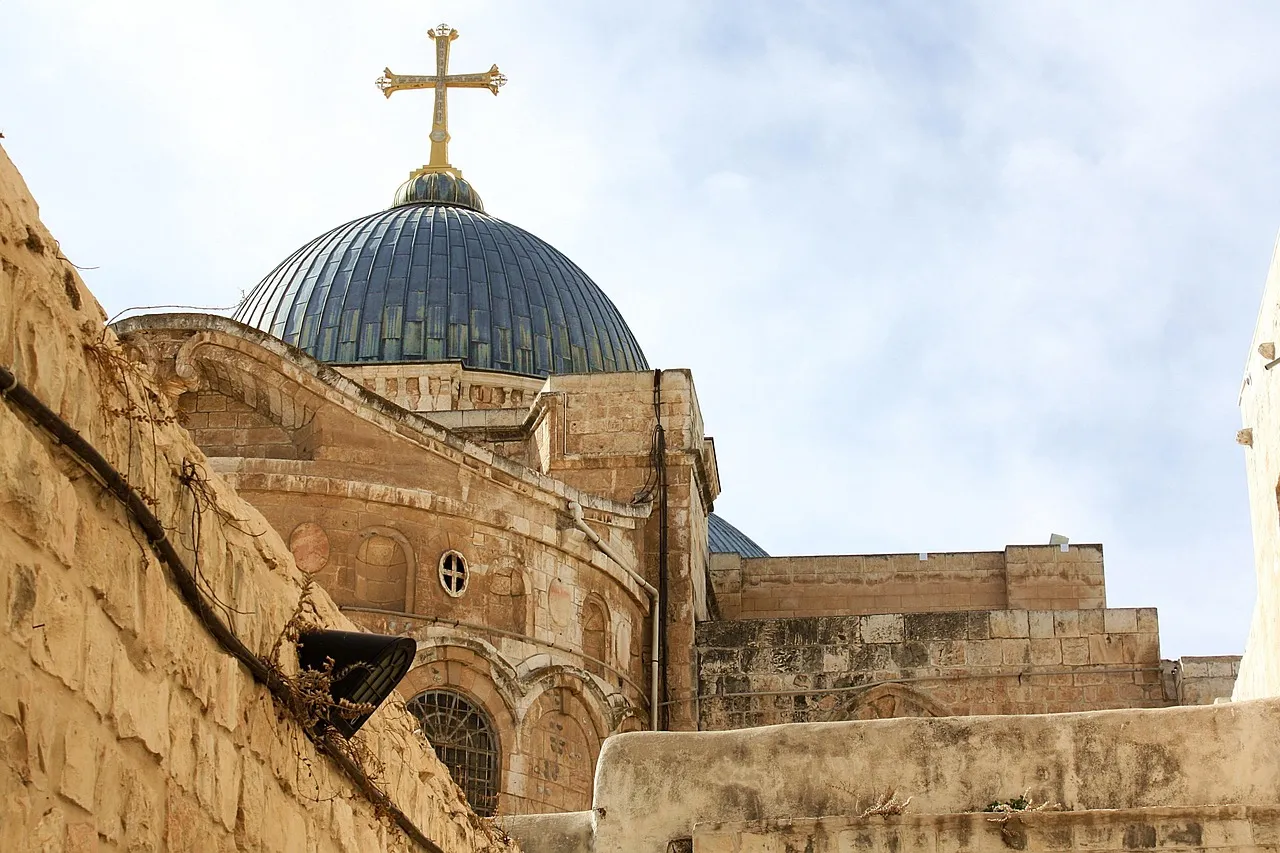
This Church of the Holy Sepulchre visitor guide covers everything a first-time pilgrim needs to know: the archaeological case for the site’s authenticity, what is actually inside, how the six denominations divide the building, and the practical details that determine whether your visit is transformative or merely confusing. The church receives 4 to 5 million visitors per year and rewards those who arrive prepared.
The Church of the Holy Sepulchre in Jerusalem’s Christian Quarter occupies the site identified since at least the 4th century as both Golgotha, the place of crucifixion, and the tomb of Jesus. For the majority of the world’s Christians — Catholic, Orthodox, and Oriental Orthodox — it is the most sacred site in existence.
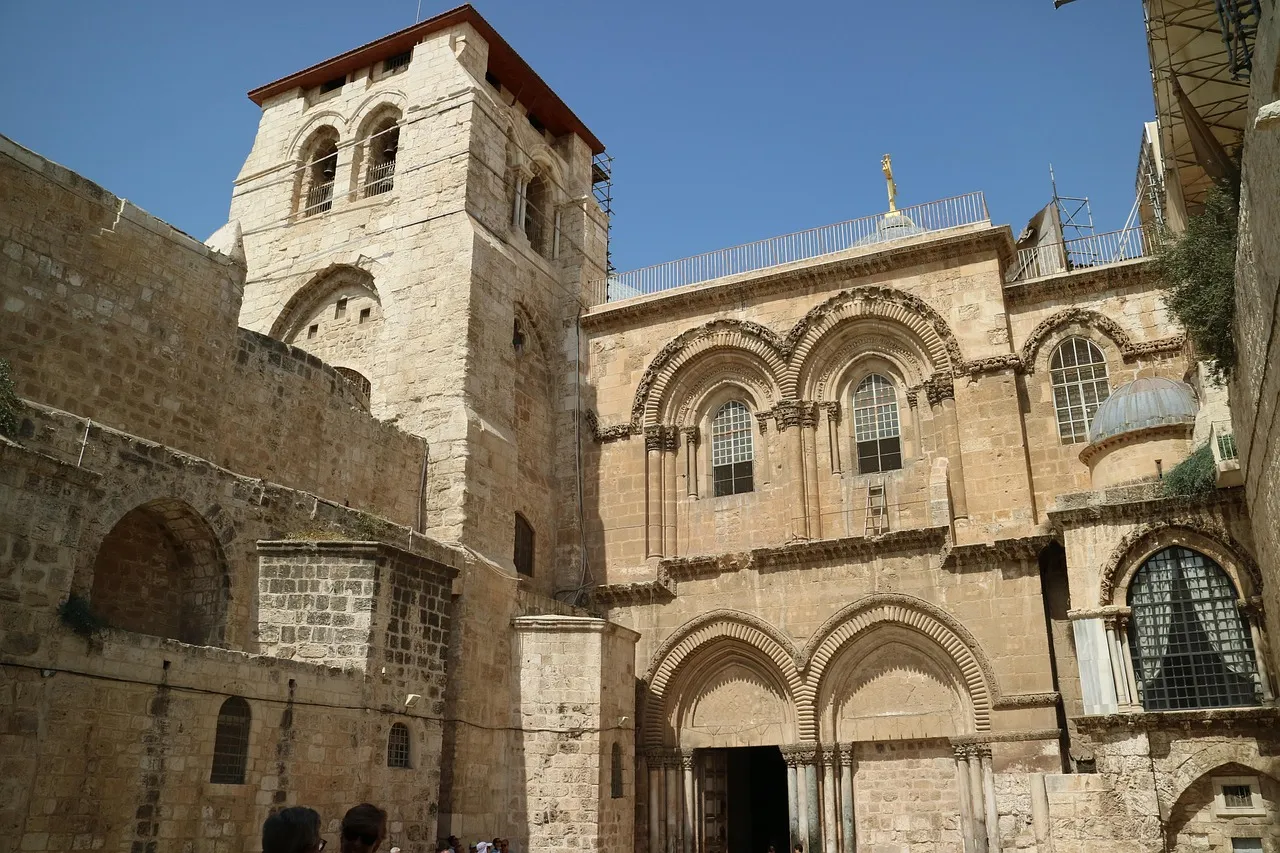
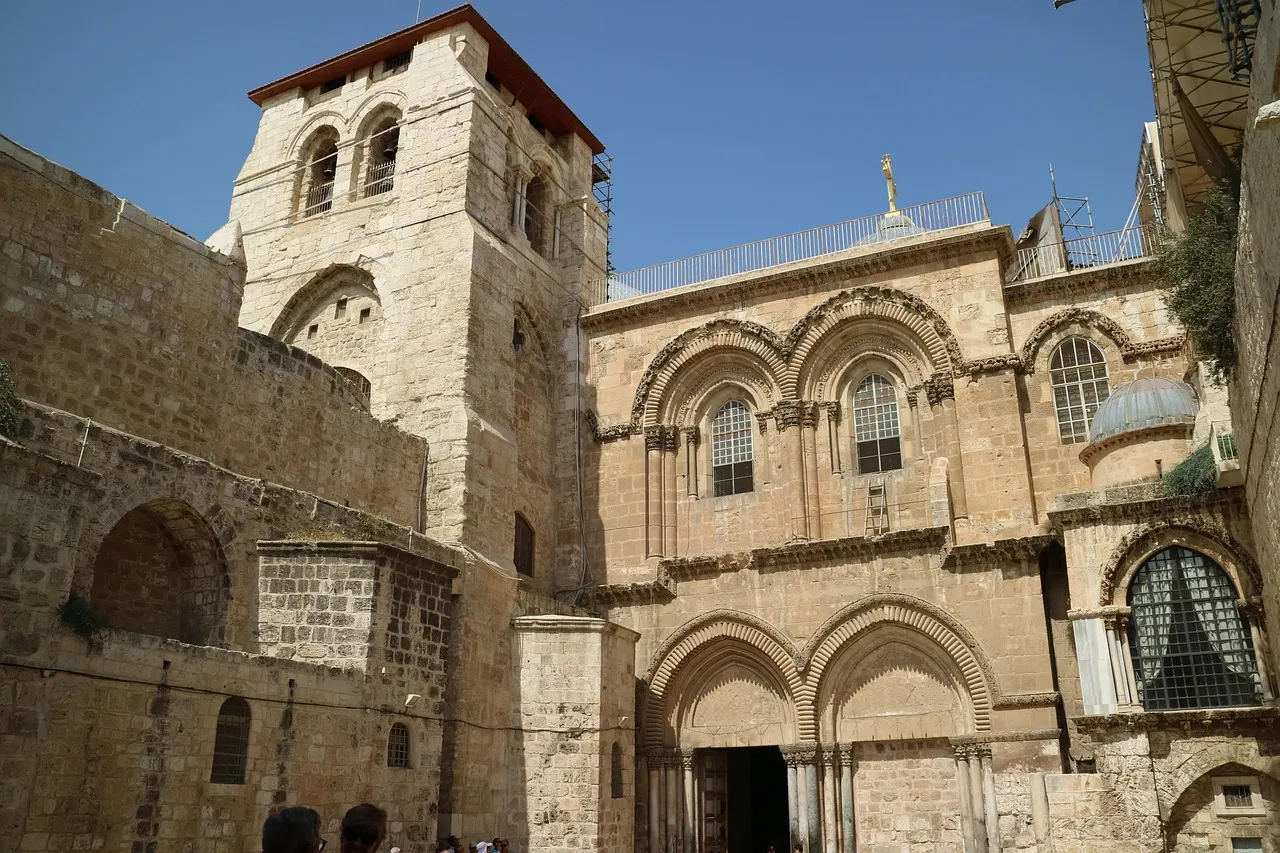
Most people arrive expecting something grander. The entrance is tucked into a courtyard off a narrow alley in the Old City, the facade is Crusader-era Romanesque, and the interior is an accumulated density of chapels, altars, icons, and incense that takes real orientation to navigate. That disorientation is part of the experience, and understanding what you are looking at before you walk in makes it considerably richer.
History and archaeology
The site’s identification with Golgotha goes back to the early 4th century. The Roman emperor Hadrian, after suppressing the Bar Kokhba revolt in 135 CE, razed Jerusalem and built a new city called Aelia Capitolina over the ruins. On the site of the crucifixion and tomb, he built a temple to Venus — almost certainly because he knew the site was sacred to Christians and wanted to overwrite it. That move preserved the location. The site stayed marked, continuously, from 135 CE through Constantine’s reign.
When Constantine legalized Christianity and commissioned a church on the site in 325 CE, his mother Helena and the local bishop Macarius supervised the removal of the Hadrianic temple. According to Eusebius of Caesarea, who was present and wrote about it in his “Life of Constantine,” what they found beneath it was a rock-cut tomb. Construction of the original Church of the Holy Sepulchre began immediately and was completed around 335 CE.
The Persian army destroyed the church in 614 CE. It was rebuilt, then partially dismantled by the Fatimid caliph al-Hakim bi-Amr Allah in 1009 CE. The Crusaders rebuilt it again on a larger scale beginning in 1099, and the Romanesque structure visible today dates largely from that period, completed in 1149.
The archaeological case for the site’s authenticity comes down to two things: location and physical evidence. On location: the site was demonstrably outside Jerusalem’s city walls in the 1st century, satisfying the requirement under Jewish law that both executions and burials occur outside the city. The northern wall of Jerusalem in Jesus’s time ran well to the south of the current church site, a conclusion supported by excavations conducted by Israeli archaeologist Dan Bahat in the 1970s and confirmed by the mapping of the so-called “Third Wall.” On physical evidence: excavations documented by the Franciscan archaeologist Virgilio Corbo between 1960 and 1980 found a 1st-century rock quarry immediately beneath the current structure. The quarry contained burial tombs cut into its eastern face, and the fill material between the quarry floor and the tombs included pottery consistent with a 1st-century date. John 19:41 describes a garden between the crucifixion site and the nearby tomb. The quarry, with its partially cut cliff face and garden fill, matches that description.
No competing site for the crucifixion and burial has physical evidence of comparable age or specificity. The Garden Tomb, identified by General Charles Gordon in 1883 and popular with Protestant visitors today, is archaeologically dated to the Iron Age, roughly 700 years before the 1st century CE. The British School of Archaeology in Jerusalem assessed it in the 1980s and found no basis for a 1st-century identification. For a broader look at how archaeology evaluates New Testament sites across the country, see what archaeology has found at the sites most associated with Jesus.
The most recent major work inside the church was the 2016-2017 restoration of the edicule — the marble structure enclosing the tomb itself — conducted by a team from the National Technical University of Athens led by professor Antonia Moropoulou. The restoration removed the iron cage that had surrounded the edicule since 1947, cleaned and repointed the marble, and for a brief period opened the burial shelf itself. The tomb rock, when exposed, was found to be intact beneath a marble covering placed there in 1555. Moropoulou’s team confirmed the burial shelf is original bedrock of the type and period consistent with a 1st-century Jewish tomb.
What you’ll see inside
The church is large and labyrinthine. First-time visitors without a guide typically miss half of it.
Immediately inside the entrance and up a steep staircase to the right is Calvary, divided into two chapels. The Latin Chapel of the Nailing of the Cross (maintained by the Franciscans) and the Greek Orthodox Chapel of the Crucifixion sit side by side at the top of the stairs. Beneath the Greek altar, through a hole in the floor, visitors can touch the exposed bedrock of the hill itself. This is the specific rock formation that gives the site the name Golgotha — in Aramaic, “place of the skull” — though the etymology may refer to the rock’s skull-like shape rather than to its use as an execution ground.
The Stone of Anointing is the long flat slab at the foot of the entrance stairs, at ground level. Tradition holds it marks the spot where Jesus’s body was prepared for burial. The current stone dates from 1810; the practice of anointing it with oil and pressing personal items against it for blessing has been continuous for centuries. Most tour groups walk past it quickly. It deserves more time than it gets.
The edicule, in the rotunda at the center of the church, is the primary destination for most visitors. The current structure was built in 1810 after fire damaged the earlier edicule. The outer marble shell is not beautiful by conventional standards — it has the proportions of a small baroque kiosk — but what it contains is the tomb. The edicule is divided into two small rooms: the Chapel of the Angel, where the angel reportedly sat after the resurrection, and the burial chamber itself, which holds the marble-covered burial shelf. A maximum of three or four visitors fit inside at one time. The queue can be an hour or more during peak periods.
The Chapel of Helena, named for Constantine’s mother, sits below the main church level and is reached by a staircase in the eastern arm of the building. It belongs to the Armenian Apostolic Church and preserves a 4th-century tradition associating the space with Helena’s discovery of the True Cross. Further down another staircase is the Chapel of the Finding of the Cross, now maintained by the Catholics, at the level of the original quarry floor. The rough stone walls at this depth are a different experience from the incensed darkness of the main level. You are looking at the rock the 4th-century builders actually cut through.
The six denominations sharing the church
The church is jointly administered by six Christian denominations: the Greek Orthodox, Roman Catholic (Franciscan), Armenian Apostolic, Coptic Orthodox, Ethiopian Orthodox, and Syriac Orthodox. The arrangement governing their respective rights is called the Status Quo, formalized by the Ottoman decree of 1852 but rooted in arrangements that pre-date it by centuries.
Under the Status Quo, each denomination owns or controls specific altars, chapels, and sections of the building. Common areas — the entrance, the stone of anointing, the edicule itself — are shared under strict protocols. No denomination may unilaterally move, alter, clean, or repair anything in a common area. Maintenance of the edicule was impossible for decades because no agreement could be reached on who would fund and oversee it. The iron cage that held the structure together from 1947 until the 2016 restoration was installed after a British engineer warned it was structurally failing — even that emergency intervention required extraordinary diplomatic coordination.
The keys to the church are held by a Muslim family, the Joudeh family, who have been the custodians since Saladin returned the church to Christian control in 1187. A member of another Muslim family, the Nuseibeh family, opens and locks the door each day using the key the Joudeh family holds. This arrangement, now over 800 years old, was designed to prevent any single Christian denomination from controlling access. It has continued through the Ottoman period, the British Mandate, Jordanian rule, and Israeli administration.
Most people who visit do not know this. Many find it stranger still when told that the arrangement works.
The immovable ladder is the most visible symbol of the Status Quo’s rigidity. A wooden ladder has sat on a ledge above the entrance portal since at least 1728 — the year of the earliest known image showing it in place. It leans against a window belonging to one denomination from a ledge belonging to another. No agreement has been reached on moving it. The ladder is where it is.
Practical visitor information
The church is open daily. Summer hours (roughly April through September) run from 5:00 AM to 9:00 PM. Winter hours close at 7:00 PM. These are approximate. During Holy Week, hours extend for liturgical services, and the church can be open continuously for portions of Holy Saturday. The Christian Information Centre, located at Jaffa Gate in the Old City, maintains current hours and can advise on liturgical schedules for specific denominations.
There is no admission fee.
Dress code: shoulders and knees covered for both men and women. This is enforced. Visitors in shorts or sleeveless tops will be turned away at the entrance.
Photography is permitted in most areas of the church, including Calvary and the edicule exterior. Flash photography inside the edicule is not permitted, and video tripods are not allowed anywhere inside the church. Some denominations restrict photography during active liturgies; follow the guidance of clergy or monitors present.
The best time for a quiet visit is on a weekday morning, arriving when the church opens. By 9:00 AM the site is filling; by noon, the edicule queue can stretch 45 minutes or more. If your group is large, coordinating a pre-dawn arrival — the church opens at 5:00 AM — is worth the effort.
The church has no official guided tour from a central authority. Each denomination offers its own guides and, occasionally, tour programs. Most licensed Israeli tour guides include the site on Jerusalem itineraries and can navigate the denominational geography effectively. Independent navigation is possible with a good map and this kind of advance preparation; without it, it is easy to spend an hour in the church and miss the Chapel of Helena entirely.
The church is in the Christian Quarter of the Old City, roughly 10 minutes on foot from Jaffa Gate. The nearest vehicle access is outside the Old City walls. Most visitors arrive through Jaffa Gate or Damascus Gate depending on where they are coming from. Independent navigation without prior preparation is possible. Getting to the Chapel of Helena, below the main floor level in the eastern arm of the building, without knowing it exists is not.
Most church groups visiting Jerusalem also spend a day in Bethlehem, 10 kilometers to the south. The Church of the Nativity visitor guide covers the equivalent practicalities for that site. If you are building out a full itinerary, the 10-day Israel church group itinerary shows how Jerusalem and Bethlehem fit into a structured pilgrimage schedule.