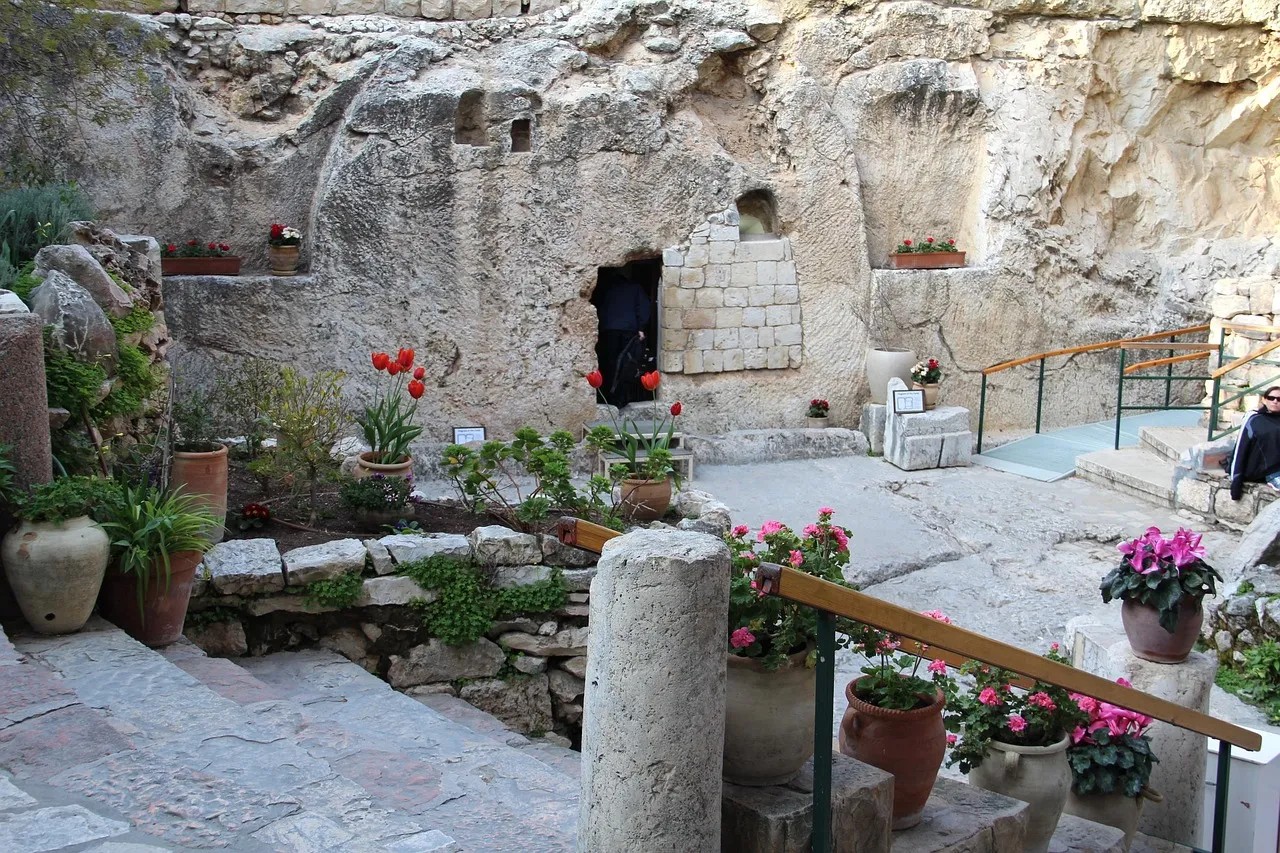
The Garden Tomb Jerusalem is a Protestant pilgrimage site just outside Damascus Gate, containing a rock-cut tomb and garden grounds that many evangelical and mainline Protestants visit as a place to remember the crucifixion and resurrection of Jesus. For many Protestant pilgrims, it is the moment the Gospel accounts stop reading like a text and start looking like a place. Church groups looking to build a Jerusalem itinerary around these sites can see how the Garden Tomb fits into our Walk Where Jesus Walked 10-day tour. The grounds sit quietly outside Damascus Gate, a short walk from the dense stone warren of the Old City, and the first impression is exactly what John 19:41 describes: a garden, a cliff, a tomb cut into rock. The air is different here. Birds, not incense. Open sky, not vaulted stone. For a Baptist pastor leading thirty people from Alabama, or a Presbyterian elder bringing his congregation from Glasgow, or an Assemblies of God group from Sao Paulo, the Garden Tomb often feels like the first place in Jerusalem where their own tradition can simply breathe.
That feeling is not an accident. The site was developed in the 19th century specifically as a place where Protestants could worship in their own idiom, without the liturgical density of the Church of the Holy Sepulchre, and it has remained so for nearly 150 years. Whether or not this is the precise rock where Jesus was laid, the Garden Tomb is something the Holy Land has in short supply: a quiet, dignified, garden-set place of evangelical worship at the scale of the Gospel events themselves.
Why Protestants found this place
The story begins with General Charles Gordon, the British military hero of Khartoum, who visited Jerusalem in 1883 on a period of religious sabbatical. Standing on the Old City walls near Damascus Gate, Gordon looked north at a rocky escarpment pocked with two cave openings and a weathered ridge that, from the right angle, reads as the eye sockets and brow of a skull. He noted that the hill sat outside the ancient city walls, near a major execution road, and within sight of a rock-cut tomb in an adjacent garden plot. He wrote up his observations, and within a decade the site had become a center of Protestant pilgrimage.
Gordon did not invent the devotion out of nothing. Through the 19th century, a generation of English, Scottish, German, and American Protestant travelers had been looking for a Holy Land they could pray in. The Holy Sepulchre, for all its ancient authority, was crowded, dim, and shared by denominations whose worship felt foreign to low-church Protestants. Gordon’s hill answered a real hunger. In 1894 a group of British Christians formed the Garden Tomb Association to purchase and steward the site, and the Association, Anglican in governance but deliberately welcoming of all evangelical and mainline Protestant traditions, has kept the grounds ever since.
That heritage matters. When a modern pilgrim walks through the gate on Conrad Schick Street, they are walking into 140 years of Protestant devotion, Scripture reading, hymn singing, and pastoral prayer. The grounds have been prayed over by generations.
What you’ll see
The visit begins with a short orientation from one of the Association’s volunteer guides, most of them retired clergy or lay leaders who have come to Jerusalem on sabbatical to serve. The guides are unhurried and warm. They walk groups to a viewing platform where, across the busy road below, the face of the escarpment comes into view: the cliff locally known as Skull Hill, or Gordon’s Calvary. The two cave hollows and the rounded ridge above them read unmistakably as a skull from this angle. The guide will note, honestly, that erosion has changed the face over the centuries, and that the Gospel writers may have meant the name Golgotha to refer to the hill’s shape, to its use, or to both.
From the viewing platform the path winds back through the garden itself. The grounds are small, perhaps two acres, but the landscaping is generous: olive trees, bougainvillea, rosemary, flowering vines against stone walls, and shaded benches arranged in small semicircles for group worship. In the middle of the grounds sits an ancient winepress cut directly into the bedrock, and nearby a large plastered cistern capable of holding roughly 200,000 gallons. Both features point to something the archaeology does confirm: this ground was, in antiquity, a working agricultural garden. A garden with a winepress and a cistern of that size belonged to someone wealthy. John 19:41 notes that the tomb belonged to a wealthy man, Joseph of Arimathea, in the place where Jesus was crucified. The physical features match the kind of place the Gospels describe, even if the specific stones may not be the specific stones.
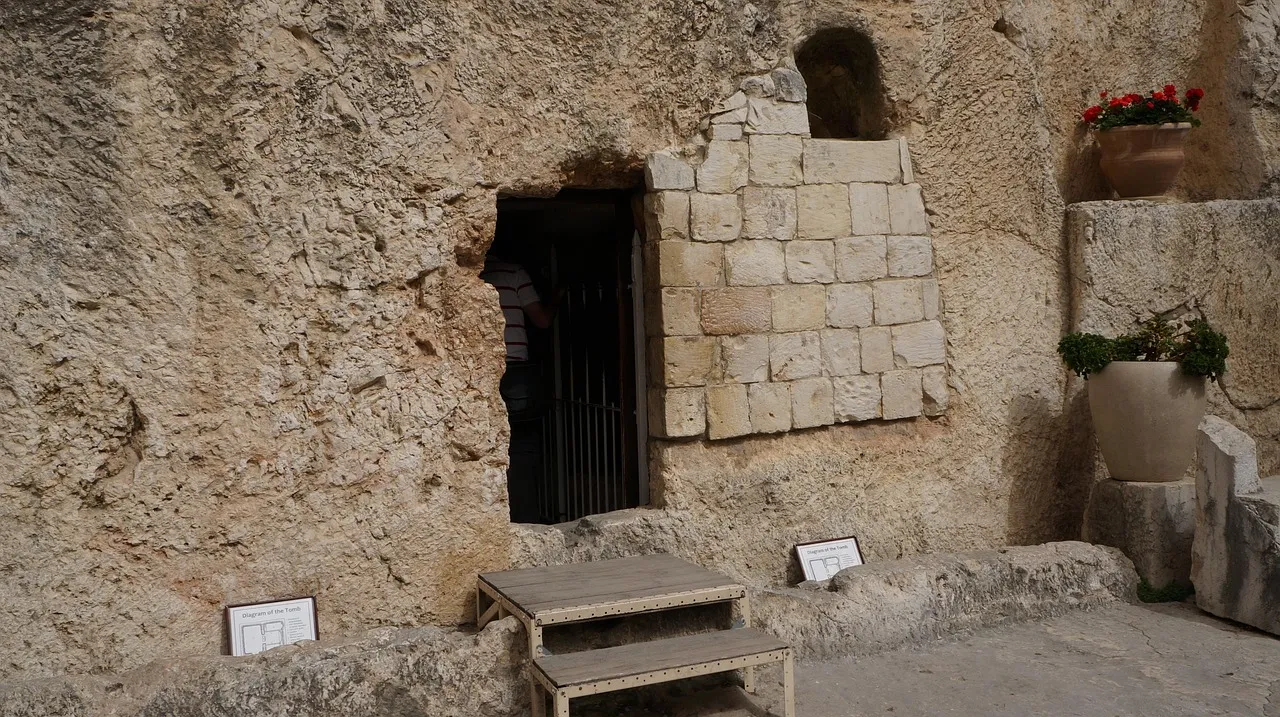
The tomb itself sits at the far end of the garden, cut into a low rock face. A shallow groove runs along the ground in front of the entrance, of the kind that would have accommodated a rolling stone. The interior is simple: a small antechamber, a burial chamber on the right with a rough stone shelf, and a window cut above the shelf that lets in a clean beam of morning light. Visitors enter two or three at a time, remove hats, and stay as long as they need. Most come out quietly.
On the archaeology
Honesty is part of the site’s character, and the archaeology deserves a clear paragraph. The rock-cut tomb at the Garden Tomb dates, on the basis of its cutting style and comparanda with other excavated tombs in the area, to the Iron Age: roughly the 8th or 7th century BCE. That is several hundred years before the 1st century CE, and a 1st-century Jewish burial of the kind described in the Gospels would normally be cut fresh, not reused from a much older tomb. The British School of Archaeology in Jerusalem reviewed the site in the 1980s and found no basis for a 1st-century identification. For readers who want a wider view of how archaeology evaluates Gospel-period sites across Israel, see what archaeology has found at the places most associated with Jesus.
The Garden Tomb Association has never claimed this is definitively the tomb of Jesus. They offer it, in their own published language, as “a place to remember,” and that honesty is part of what makes the site trustworthy. A tomb does not have to be the tomb to be holy ground. A garden does not have to be the garden to be a place where the risen Christ is real to those who come looking for him. Protestant pilgrims have always been a people of the Word over the relic, and the Garden Tomb, precisely because it does not trade on archaeology, lets Scripture do the work.
Worship at the Garden Tomb
This is what brings most Protestant groups back. Across the grounds, the Association has set aside roughly two dozen reserved worship areas: shaded benches facing a simple wooden communion table, some in full sun, some under olive canopy, most within sight or sound of the tomb itself. Groups book these slots in advance, and during a slot the space is theirs. A pastor can preach at normal volume. A congregation can sing. A small Anglican choir can work through a full communion liturgy. A non-denominational group from Texas can pass the bread and the cup down a row of folding chairs while the pastor reads from Luke 24.
The quality of silence between songs is the thing veterans of the site mention most. Jerusalem is a loud city, but the walled grounds of the Garden Tomb absorb the noise. When thirty voices finish the last verse of “In Christ Alone” and stop, there is a pause in which you can hear olive leaves.
For a pastor or group leader, the pastoral value is hard to overstate. Many in the group will have come to Israel hoping to touch the Gospel accounts with their own hands, and the Garden Tomb gives them a setting where the touching is possible in their own language of worship. Hymns they grew up with. Communion the way their home church does it. A prayer at the mouth of a tomb, with the rolling stone groove visible at their feet.
Booking is essential. Worship slots can be reserved through the Garden Tomb Association’s website or by emailing the office directly. Peak-season slots (March through May, September through November) routinely book out four to six months ahead. Groups of 30 or more should plan further out still. The Association does not charge for worship slots; a donation at the end of the service is customary and goes directly to grounds maintenance and the volunteer program.
Planning your visit
The Garden Tomb is on Conrad Schick Street in East Jerusalem, a five-minute walk north of Damascus Gate. The entrance is a plain green door in a stone wall, easy to miss. Most tour coaches drop groups on Nablus Road and walk the last block in. Opening hours are typically Monday through Saturday, 8:30 AM to 12:00 PM and 2:00 PM to 5:30 PM, with a midday closure. The site is closed on Sundays and on certain Christian holidays. Confirm current hours directly with the Association before finalizing a group itinerary.
Admission is free. A small donation at the gift shop or exit box is welcomed and funds the work of the Association. The gift shop, near the entrance, carries Scripture materials, olivewood communion sets, and prints of the site, and is one of the few places in Jerusalem where a Protestant pilgrim can buy a thoughtful keepsake without wading through mass-market religious trinketry.
Restrooms are on site. Bottled water is available at the gift shop. The grounds are mostly step-free with ramped paths, though the tomb entrance itself has a low threshold that requires a small step down. Wheelchairs can reach the viewing platform and the worship areas; the tomb interior is narrow.
A self-guided visit with the volunteer introduction takes 45 to 60 minutes. A booked worship slot with communion extends the visit to roughly 90 minutes. Groups that are combining the Garden Tomb with the Old City often pair it with a morning walk through the ramparts or an afternoon at the Western Wall, both within 20 minutes on foot. Bring a Bible. That is the one thing everyone who has led a group here wishes they had told their people to carry in.