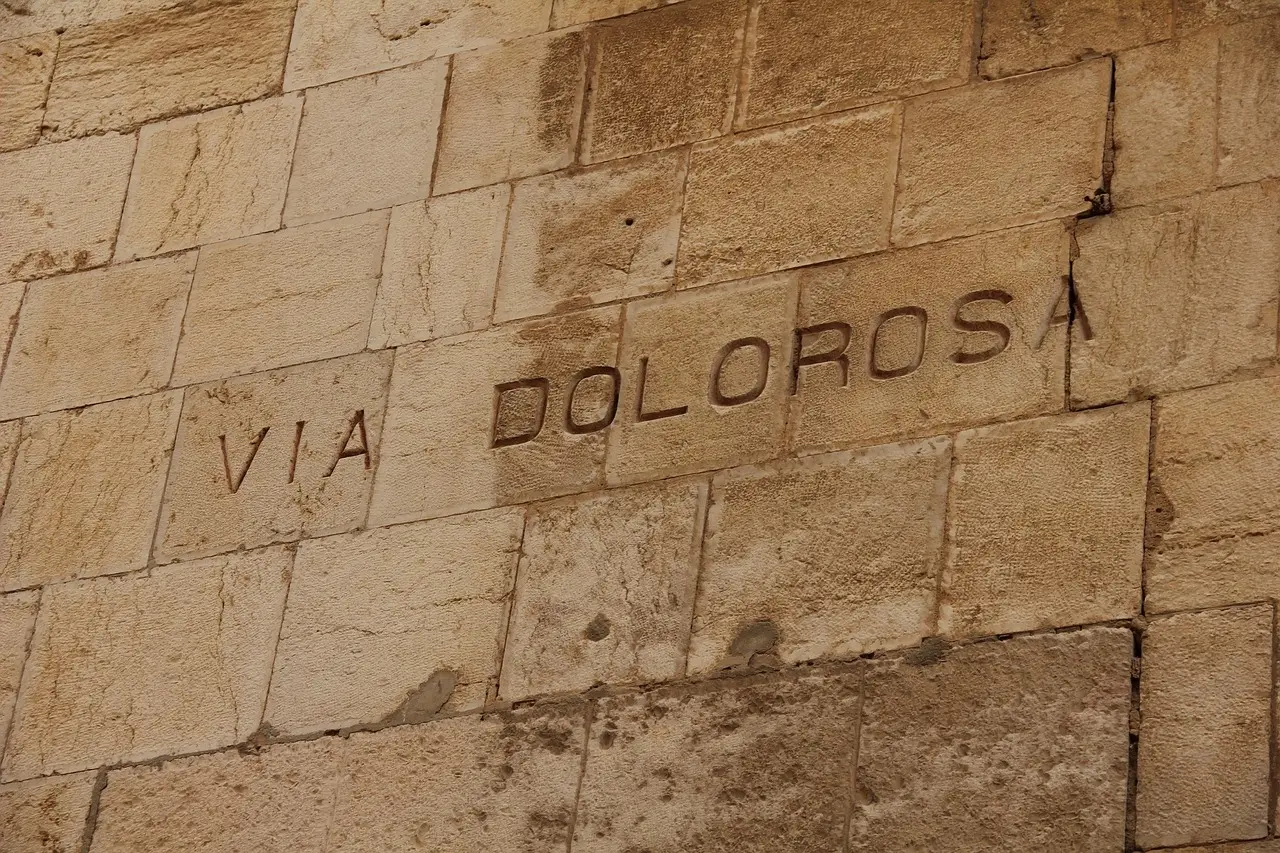
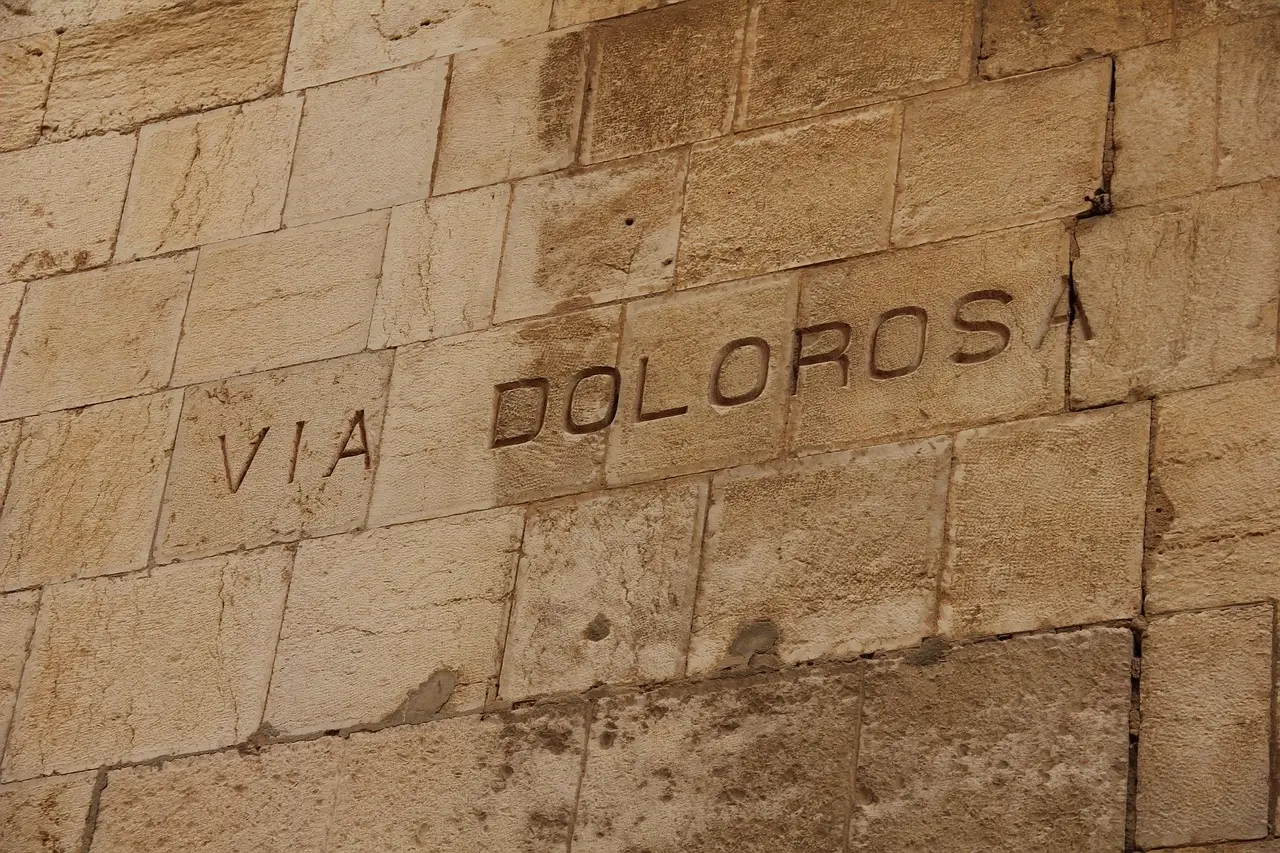
The Via Dolorosa stations guide most people carry into Jerusalem’s Old City lists fourteen stops. What it can’t prepare them for is the market noise.
The route runs through the Muslim Quarter, and on any given morning the street is full: shopkeepers pulling shutters, schoolchildren cutting through to class, tourists navigating with phone screens pointed at the sky. The smell of za’atar and fresh bread comes from the stalls. A vendor waves you toward a cart of pomegranates. And somewhere in the middle of it, a small plaque on a stone wall marks the place where tradition says Jesus fell for the first time under the weight of the cross.
That friction between the ordinary and the sacred is not a distraction from walking the Via Dolorosa. It is the walk. Jesus carried his cross through a city full of people going about their day. Most of them didn’t stop either.
The route is about 600 meters from the first station to the entrance of the Church of the Holy Sepulchre. It begins near Lions’ Gate in the northeastern corner of the Old City and ends inside the church, where the last five stations are located. Fourteen stations total. Nine on the street, five inside the church. Church groups walking the Via Dolorosa as part of a structured itinerary can see how Jerusalem’s final days are sequenced in our 10-day Walk Where Jesus Walked tour.
Isaiah wrote it centuries before it happened: “He was despised and rejected by mankind, a man of suffering, and familiar with pain” (Isaiah 53:3). Walking the Via Dolorosa is one way to sit with what that line actually means.
Stations I-IV: from the Praetorium to the fourth encounter
The first two stations are at the Monastery of the Flagellation and the adjacent Chapel of the Condemnation, both maintained by the Franciscans. The complex sits just inside Lions’ Gate on a street called Al-Mujahideen. The gate itself is also called St. Stephen’s Gate, named in memory of the first Christian martyr stoned nearby (Acts 7:60).
Station I marks the site where Pilate condemned Jesus. The archaeological reality is more complicated than the plaque suggests. The actual location of Pilate’s judgment hall is debated. Many scholars associate it with the Antonia Fortress, which stood here on the northern edge of the Temple Mount. Others place the trial at Herod’s palace near Jaffa Gate. The Franciscan complex memorializes the traditional site, which has been part of the pilgrimage route since at least the medieval period.
The Chapel of the Condemnation at Station I is small, octagonal, and quiet in the early morning before tour groups arrive. The floor uses stones that were part of a Roman-era pavement, cracked and worn but original. You stand on something that was here.
Station II is inside the Church of the Flagellation, across a small courtyard. This is where Jesus received the crown of thorns and was handed the cross. The church was rebuilt by the Franciscans in the 1930s and has three notable stained glass windows: one showing the flagellation, one showing Pilate washing his hands, and one showing Barabbas going free. The window of Barabbas is the one that stops people. He walked out. Someone else walked out carrying what should have been his.
Stations III and IV are a short walk down Via Dolorosa toward the west. Station III marks the first fall of Jesus. There is a small Polish chapel here with a carved relief above the door showing the moment. Station IV, just a few meters further, marks where Jesus is said to have looked at his mother in the crowd. An Armenian Catholic oratory at this location has a mosaic beneath the entrance showing the sandaled feet of Mary as she stands along the route. Two sets of footprints preserved in the stone floor of the oratory, now worn smooth, are the kind of detail that takes a second to register.
Stations V-IX: through the market
After Station IV the route turns right onto Via Dolorosa proper, climbing the main street that runs west toward the Christian Quarter. This stretch is where the walk gets physically immersive. The street narrows, the market stalls press in from both sides, and the incline is enough to understand why carrying a heavy cross here would bring a person to their knees.
Station V is where Simon of Cyrene was pulled from the crowd and made to carry the cross for Jesus. The Gospel of Mark names not just Simon but his sons, Alexander and Rufus, as if the original readers would know who these people were (Mark 15:21). There is a Franciscan oratory at this station with a worn groove in the stone doorpost said to be where Jesus placed his hand as he walked past. Pilgrims press their palms into the same groove. Whatever its origin, the stone is warm from the contact.
Station VI is where, according to tradition, a woman named Veronica wiped the face of Jesus and an image of his face was left on her cloth. Veronica does not appear in the four canonical Gospels. The story developed in later Christian tradition and is first clearly attested in the 14th century. This doesn’t empty the station of meaning. The impulse to reach toward someone suffering, at personal cost, is exactly what the Gospels ask of the people around Jesus. A small Greek Catholic church marks the station.
Station VII is at a busy intersection where the route crosses the main market thoroughfare, the Suq Khan ez-Zeit. A pillar here is said to have held the gate to the old city, making this the point where Jesus crossed from the inhabited quarters to the road outside the walls. There is a Franciscan chapel at this station, and the market continues on both sides. You buy water at this intersection before going further.
Station VIII is marked by a Latin cross carved into the wall of a Greek Orthodox monastery at street level. This is where Jesus turned to address the women of Jerusalem: “Daughters of Jerusalem, do not weep for me; weep for yourselves and for your children” (Luke 23:28). The marking is easy to miss if you are not looking for it. A small circle of tiles on the wall at shoulder height.
Station IX is at the entrance to the Coptic Orthodox Patriarchate, reached by turning right and climbing a set of stairs that bring you up to the roof of the Church of St. Helena, which is itself part of the Church of the Holy Sepulchre below. The third fall of Jesus is commemorated here. The Ethiopian Orthodox community maintains a monastery on this same rooftop, a quiet collection of monk’s cells around a small courtyard. If the gate is open, it is worth stepping in. The monks are generally welcoming to respectful visitors.
Stations X-XIV: inside the Church of the Holy Sepulchre
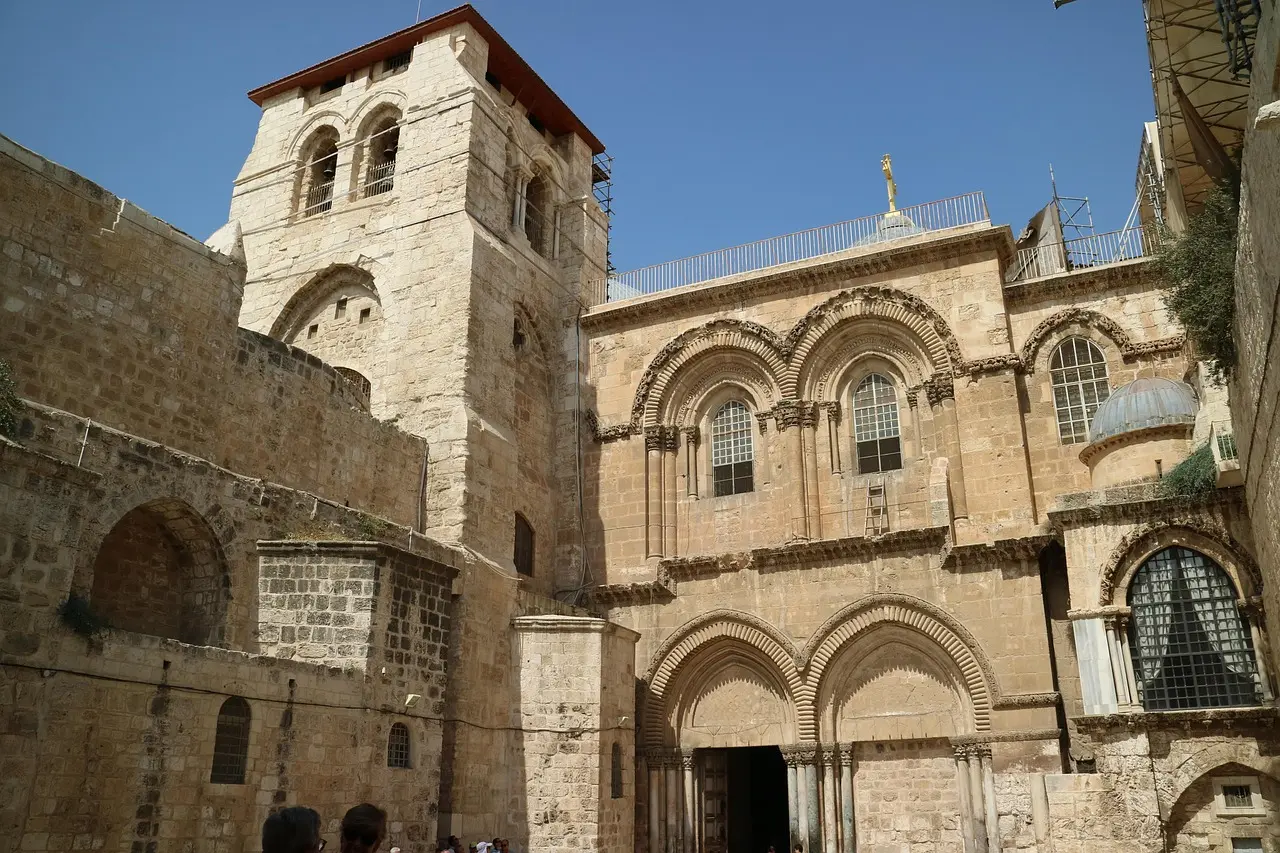
The final five stations are not on the street. They are inside the Church of the Holy Sepulchre, and the transition from the noise of the market to the interior of the church is immediate and complete. The smell changes first, from bread and exhaust to incense and stone. The light drops. Your eyes adjust.
Stations X and XI are at the top of the steep staircase to the right inside the main entrance, which brings you to Calvary. Golgotha in Aramaic, meaning the place of the skull. The hill itself is preserved inside the church, and the chapels at the top of the stairs are built directly on it.
Station X is the Latin Chapel of the Nailing of the Cross, maintained by the Franciscans. Station XI is the Greek Orthodox Chapel of the Crucifixion, where the larger altar stands. These two chapels share the upper floor, side by side. Under the Greek altar, a hole in the floor allows visitors to reach down and touch the bedrock of the hill. Pilgrims queue for this. The rock surface is cold under your hand and pitted from centuries of contact.
Station XII, the death of Jesus, is marked at the Greek altar directly above the rock. The silver disc marking the spot of the cross is surrounded by oil lamps that the Greek Orthodox have kept burning continuously. The lamps move slightly from the breath of the people passing beneath them.
Station XIII is at the foot of the staircase, back at ground level, at the Stone of Anointing. This long flat slab is where, according to tradition, the body of Jesus was prepared for burial after being taken down from the cross. The current stone dates from 1810. People lay items against it, press their foreheads to it, anoint it with oil they have brought in small bottles from shops in the market. The smell of the oil mixes with the incense. This station doesn’t have a plaque the way the others do. You will know it by the people gathered around it.
Station XIV is the tomb itself, inside the edicule at the center of the rotunda. The edicule is the marble structure in the middle of the church, built over the burial cave. The queue for the edicule can run 45 minutes or more during peak periods. Inside, there are two small rooms: the Chapel of the Angel and the burial chamber. The burial shelf is covered in marble. Three or four people fit inside at one time. There is almost never a moment when the space is empty.
The walk ends here. There is no sign saying so, no marker on the floor. You come out through the same low door you entered, back into the incense and lamplight of the rotunda. The noise from the market outside is muffled but present.
John 19:30 has three words at the cross: “It is finished.” Whatever those words contain, you are standing as close to the place where they were spoken as anyone can get.
Practical information for walking the Via Dolorosa
The Friday procession led by the Franciscans leaves from the Chapel of the Condemnation at 3:00 PM every week. Current schedule details are maintained by the Custody of the Holy Land, the Franciscan body that has administered the route since 1342. It stops at each station for prayer and Scripture readings and ends inside the Church of the Holy Sepulchre. It is open to anyone. During Holy Week the procession draws very large crowds, and the narrow streets on the route become genuinely difficult to navigate for anyone who is not comfortable in close quarters.
For groups walking the route independently, Friday morning is the best window. The market is less active in the morning than in the afternoon, and walking before 10:00 AM gives you space at each station before crowds build. The full walk with meaningful stops at each station takes 90 minutes to two hours, not counting time inside the church at the end.
Wear shoes with grip. The stone streets of the Via Dolorosa are uneven and worn smooth in places, and the section near Station IX requires climbing stairs. In wet weather the paving stones can be slippery. There is no flat, level terrain on this route.
Dress as you would for any religious site in the Old City: shoulders and knees covered. The Church of the Holy Sepulchre enforces this at the entrance. You will not be admitted otherwise.
The station plaques are mounted on walls at roughly eye level, mostly in Latin with numbers. Some are marked with additional text or small chapels; others are a plaque and nothing else. On a busy day, particularly near Station VII at the main market crossing, the plaque can be genuinely difficult to find with people moving through the intersection in all directions. Download a Via Dolorosa map to your phone before you walk, not just a street map but one that marks each station specifically.
A licensed guide changes the quality of the walk. The historical complexity of the stations, the archaeological debates about location, the denominational ownership of each site, the Scripture passages most associated with each stop: a good guide holds all of this together in real time, in the actual place. For groups, the investment in a guide generally pays for itself before Station IV.
If your group is visiting Jerusalem during Holy Week, the Via Dolorosa on Good Friday is a completely different experience from any other Friday of the year. The city fills with pilgrims carrying crosses. Processions from different countries and denominations arrive throughout the day. The route is emotionally and physically intense. Come early, move slowly, and be patient with the crowds.
The walk is 600 meters. It took Jesus everything he had.