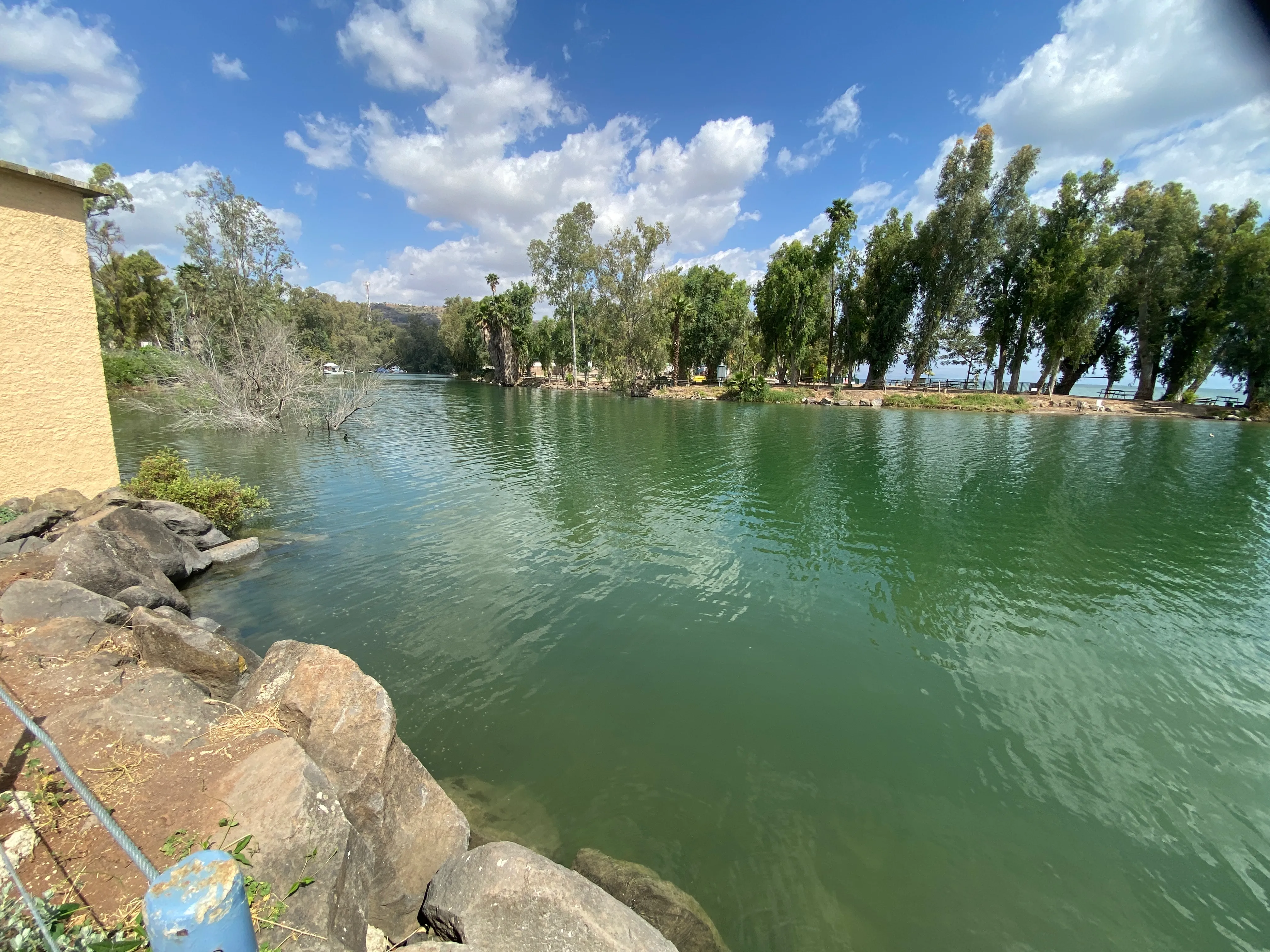
The Jordan River in the Bible carries more theological weight per kilometer than any other body of water in scripture. It is the boundary of the Promised Land, the site of Israel’s entry under Joshua, the setting for Elijah’s ascent, the place where Naaman was cleansed, and the river in which Jesus was baptized. Geographically modest, scripturally enormous. This guide walks through the river’s biblical history from source to mouth and across both Testaments, with the archaeological caveats where the evidence is partial and the textual notes where the tradition is layered. Groups planning to visit the Jordan River as part of a church pilgrimage can see how it fits into a full 10-day route on the Walk Where Jesus Walked tour, which includes the baptism site on Day 5 and places it within the arc of Jesus’ ministry from Galilee to Jerusalem.
Geography and hydrology
The Jordan rises on the southern slopes of Mount Hermon, fed by three principal springs: the Banias at the base of the ancient sanctuary of Pan, the Dan at Tel Dan, and the Hasbani in southern Lebanon. These streams converge in the Hula Valley and flow south through the Sea of Galilee, a freshwater lake 209 meters below sea level, then continue another 105 kilometers to terminate in the Dead Sea at 430 meters below sea level. Total length, accounting for the river’s meanders, runs roughly 250 kilometers. Linear distance from the Galilee outflow to the Dead Sea is closer to 105 kilometers, but the lower Jordan loops through so many switchbacks that its actual channel more than doubles that figure.
Modern flow is a fraction of the ancient flow. Israel, Jordan, and Syria all draw heavily on the Jordan’s tributaries for irrigation, and the National Water Carrier diverts much of the upper Jordan northward into Israel’s distribution network. The river that pilgrims see at the lower Jordan today carries an estimated 2 to 3 percent of its pre-1950s volume. In the biblical period it was a substantial, often unfordable river, particularly during the spring snowmelt from Hermon. Joshua 3:15 specifies that the crossing under Joshua occurred at flood stage, which in the lower Jordan typically falls in March or April.
Joshua’s crossing and the stones at Gilgal
The crossing narrated in Joshua 3 and 4 functions as a deliberate parallel to the Red Sea crossing in Exodus 14. The waters are cut off upstream, the people pass on dry ground carrying the Ark of the Covenant, and twelve stones are taken from the riverbed and set up at Gilgal as a memorial. The text in Joshua 3:16 specifies that the waters stood in a heap as far away as Adam, a town identified with Tell ed-Damiyeh roughly 30 kilometers north of Jericho.
The geology of that stretch of the Jordan is informative. Israeli geologist Amos Nur and others have documented that the riverbanks at Adam are unstable marl cliffs prone to seismic landslides. Recorded blockages of the river at this exact spot occurred in 1267, 1546, 1834, and 1927, the last of which dammed the Jordan for 21 hours. None of this proves or disproves the biblical event, but it identifies a real geological mechanism that would produce the described phenomenon. The narrative’s theological claim rests on timing, not on physics.
Gilgal itself has not been definitively located. Several candidate sites east of Jericho, including Khirbet el-Mafjir and the so-called “foot-shaped enclosures” surveyed by Adam Zertal beginning in the 1980s, have been proposed. Zertal’s identification remains contested. The traditional pilgrimage site associated with the crossing today is at Qasr el-Yahud, the same stretch of river identified with Jesus’s baptism, which is treated more fully in our guide to the Qasr el-Yahud baptism site.
Elijah, Elisha, and Naaman
The Jordan figures prominently in the prophetic narratives of 1 and 2 Kings. In 2 Kings 2, Elijah strikes the river with his rolled-up cloak and the waters part, allowing him and Elisha to cross to the eastern bank. Elijah is then taken up to heaven in a whirlwind, and Elisha returns to strike the river with the same cloak, repeating the parted waters as a sign that the prophetic mantle has passed to him. The location is described as opposite Jericho, placing it in the same general area as the Joshua crossing and the later baptism site. Byzantine-era pilgrim itineraries, including that of Egeria in the late 4th century, treat the three events as occurring at essentially the same bend of the river.
Naaman the Syrian appears in 2 Kings 5. Sent by the prophet Elisha to wash seven times in the Jordan to cleanse his leprosy, Naaman initially objects that the Damascus rivers are cleaner. The narrative’s force depends on the Jordan being unimpressive: the healing comes from obedience, not from the water itself. The episode is cited in Luke 4:27 by Jesus as an example of God’s grace extended beyond Israel.
John the Baptist in the wilderness
John’s ministry is located in the Judean wilderness near the lower Jordan. Matthew 3 and Mark 1 identify the setting as the wilderness east of Jerusalem, and John 1:28 specifies Bethany beyond the Jordan as the place where John was baptizing. This Bethany is distinct from the Bethany near Jerusalem associated with Lazarus. The reference is to a settlement on the eastern bank, identified since the 4th century with the area now called Al-Maghtas in Jordan, with corresponding pilgrimage activity at Qasr el-Yahud directly across the river on the western bank.
The choice of location matters. The Jordan was the boundary Israel crossed to enter the land. By summoning Jews into the wilderness east of the river and asking them to be immersed before re-crossing, John staged a symbolic re-entry, framing his baptism as repentance and renewed covenant. The geography is the theology. Anyone walking where Jesus walked, archaeologically speaking, arrives at this stretch of water with the Joshua narrative already underneath the Gospel narrative.
Jesus’s baptism
The baptism account appears in all four Gospels, with the fullest version in Matthew 3:13-17. Jesus comes from Galilee to the Jordan, is baptized by John, and as he comes up from the water the heavens open, the Spirit descends as a dove, and a voice declares, “This is my beloved Son, in whom I am well pleased.” The phrasing echoes Psalm 2:7 and Isaiah 42:1, identifying Jesus simultaneously as messianic king and suffering servant. The synoptic tradition treats this as the inauguration of his public ministry.
The location, again, is Bethany beyond the Jordan. Pilgrim accounts from the 4th century onward identify the spot at what is now Al-Maghtas on the Jordanian side and Qasr el-Yahud on the Israeli-administered western side. UNESCO inscribed Al-Maghtas as the baptism site in 2015, citing Byzantine church remains and a continuous pilgrim record. Israeli archaeologists working at Qasr el-Yahud have documented Byzantine and medieval church foundations on the western bank, including a 5th-century church identified by Father Bargil Pixner. The two sites are roughly 40 meters apart across the river. Treating them as one site, separated only by the modern border, reflects the archaeology better than treating either as definitive.
The river’s flow at this stretch is now slow, brown, and narrow, often less than 10 meters wide in late summer. In the 1st century it was wider and faster. The water itself was always sediment-heavy. Pilgrims expecting clear water are sometimes disappointed; ancient pilgrims, including Egeria, describe it the same way.
Early church baptism and the Constantinian shift
For the first three centuries of Christianity, baptism took place in any available natural water. The Didache, a late 1st or early 2nd-century church manual, explicitly directs baptism in running water where possible, with still water or pouring as fallbacks. The Jordan was favored for symbolic reasons but was not normative for converts living far from it. Tertullian, writing around 200 CE in North Africa, treats sea, river, and pool as theologically equivalent.
The Constantinian period changed the architecture more than the theology. After 313 CE, churches with attached baptisteries became standard. By the 5th century, the great octagonal baptisteries at Rome, Milan, and Ravenna were operating on a fixed Easter Vigil cycle, with adult catechumens immersed inside the structure. The Jordan retained its pilgrimage status, drawing visitors precisely because they had been baptized elsewhere and wanted the symbolic immersion at the source. The travel logs of Egeria and the Bordeaux Pilgrim of 333 CE both describe the river as a destination for re-affirmation, not for original baptism.
Modern significance and the two banks
Roman Catholic and Orthodox tradition affirms infant baptism by pouring or sprinkling, with adult immersion at the Jordan understood as a renewal of baptismal vows rather than a sacramental baptism. Most Protestant pilgrims, particularly Baptists and evangelical groups, treat the Jordan as the appropriate place for full-immersion believer’s baptism, often re-baptizing adults regardless of prior infant baptism. The pastoral and liturgical practice differs sharply by denomination, but the river accommodates both. Group leaders planning the logistics will find the considerations laid out in the guide to planning a group baptism in the Jordan.
The two banks of the lower Jordan present pilgrims with a choice. The Jordanian side, Al-Maghtas, holds the UNESCO designation and the older continuous pilgrim record. The Israeli-administered western side, Qasr el-Yahud, sits on the same water and is more accessible from a Jerusalem-based itinerary. Yardenit, near the Sea of Galilee, is a 20th-century site with no biblical association but with controlled facilities suitable for large groups; it is covered in detail in the Yardenit baptism guide and the broader Jordan River baptism guide. Pilgrims continuing north to the Galilee region will find the regional context in the Sea of Galilee guide.
The choice between the sites is real, and the answer depends on what the pilgrim wants the water to mean. The river is the same water, and it has been carrying that meaning for a long time.