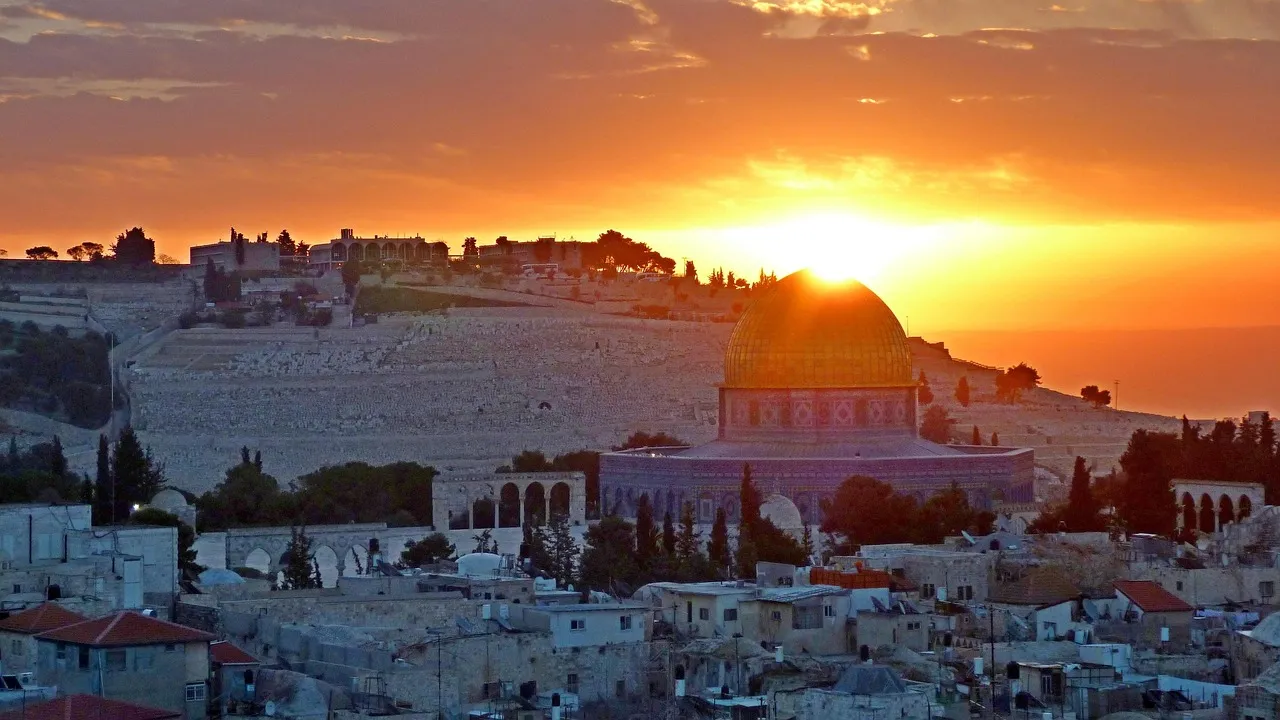
The Mount of Olives is a 3.5-kilometer limestone ridge directly east of Jerusalem’s Old City, rising to 826 meters (2,710 feet) above sea level. The western slope faces the Temple Mount across the Kidron Valley, about 90 meters below the summit. More Gospel narrative takes place on this ridge than anywhere else outside Jerusalem itself: the triumphal entry, the Olivet Discourse, the agony in Gethsemane, and the ascension. Zechariah 14:4 adds a future dimension, describing the mount as the place where the Lord’s feet will stand at the day of the Lord.
This guide covers every site a pilgrim can visit on the ridge, from the summit down to the Kidron Valley, with the biblical events attached to each and the archaeological record where it exists. The Mount of Olives is Day 6 on our Walk Where Jesus Walked 10-day pilgrimage, positioned at sunset to sequence Gethsemane before Jerusalem’s final days.
Orientation: how the ridge is laid out
Three peaks form the broader ridge running north to south. The northernmost is Mount Scopus, now dominated by the Hebrew University campus. The central peak, at 826 meters, is the Mount of Olives proper and holds the Chapel of the Ascension, Pater Noster, the viewpoint, and the main sites associated with the Gospel narrative. The southern peak, sometimes called the Mount of Offense or Mount of Corruption (from 2 Kings 23:13, referring to Solomon’s high places), is largely residential today.
Most visits work downhill. Groups are typically dropped at the summit, walk south along the ridge through the Christian sites, then descend the ancient road down to Gethsemane and cross the Kidron into the Old City via the Lions’ Gate. The walk from the Chapel of the Ascension to Gethsemane is about 1.2 kilometers on foot and drops roughly 90 meters in elevation. Allow two to four hours depending on how many sites you enter.
Chapel of the Ascension
The small octagonal chapel on the summit enshrines a stone that Byzantine tradition identified as bearing the footprint of Christ at the ascension (Acts 1:9-12). The first church on the site, called the Imbomon (Greek for “on the hill”), was built around 390 CE by the Roman noblewoman Poemenia. Egeria, the Galician pilgrim, visited in 384 and described the original structure as open to the sky, consistent with the tradition that Christ ascended into heaven from this exact point.
The Persians destroyed the Imbomon in 614 CE. Crusaders rebuilt it in the 12th century as the structure visible today, a small stone aedicule about 3 meters in diameter with an octagonal plan. Saladin converted the building to a mosque in 1198 after the Crusader defeat at Hattin, and it has remained under Muslim custodianship since. Christians of various denominations are permitted to celebrate the feast of the Ascension here annually, a cooperative arrangement that has held for roughly 800 years.
The “footprint” stone inside the chapel is worn enough that its outline is no longer obvious. What is notable is the continuity: this is the same stone venerated in the 4th century, preserved through Persian destruction, Crusader rebuilding, and Islamic custodianship. Admission is a small fee paid to the Muslim caretaker at the gate.
Pater Noster (Church of the Our Father)
A short walk south of the Ascension chapel, the Carmelite convent of Pater Noster stands on the site that tradition associates with the teaching of the Lord’s Prayer (Luke 11:1-4) and with the Olivet Discourse of Matthew 24-25. The connection is old. Constantine’s mother Helena commissioned a church here around 326 CE called the Eleona (Greek for “olive grove”), which Eusebius describes in his account of the Constantinian building program. The Eleona was destroyed by the Persians in 614.
Excavations directed by the French architect Louis-Hugues Vincent between 1910 and 1927 uncovered the foundations of the Byzantine basilica, including a crypt cut directly into the bedrock and identified by Vincent as a cave associated with the teaching ministry of Jesus. The current church, begun in 1874 and still incomplete, is maintained by the Carmelite order. Its most recognized feature is the cloister, where the Lord’s Prayer is rendered on ceramic tile panels in over 140 languages, including Aramaic, Amharic, Hawaiian, and Esperanto. Pilgrims routinely look for their own language; many find two or three.
Tomb of the Prophets
Further down the slope, a small, rarely crowded site contains a cave complex with roughly 38 burial niches arranged in three concentric galleries. Medieval Jewish tradition identifies it as the burial place of the prophets Haggai, Zechariah, and Malachi, which would place the tombs in the late 6th or 5th century BCE. Archaeological analysis, most thoroughly by the French scholar Charles Clermont-Ganneau in the 1870s, dates the tombs to the late Second Temple period, roughly the 1st century BCE through the 1st century CE. The identification with the prophets is therefore traditional rather than archaeological.
The site is free to enter and maintained by a private Jewish caretaker. Bring a flashlight; the galleries are not lit.
Panoramic viewpoint
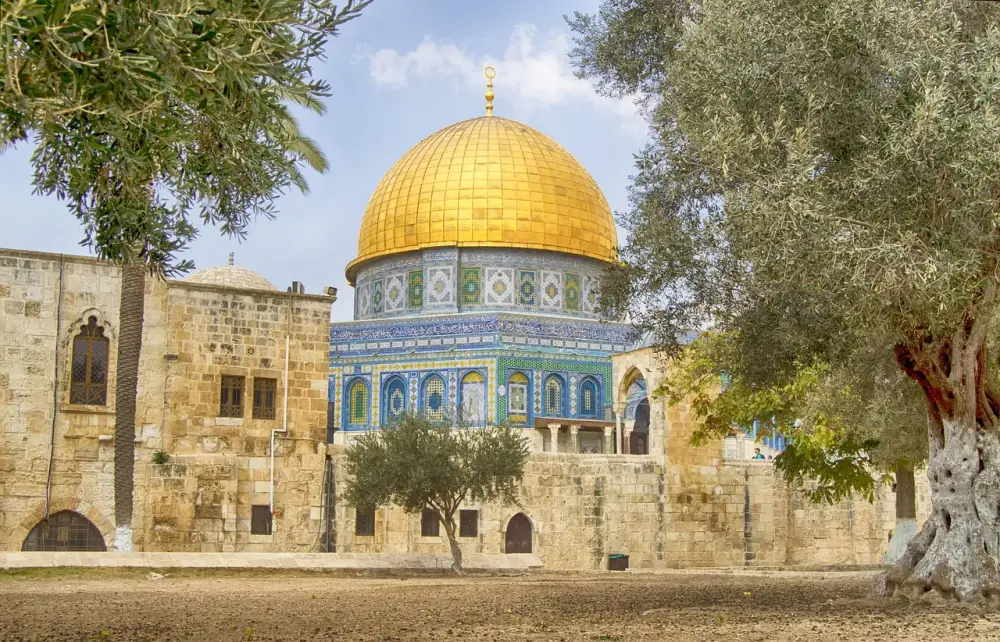
The promenade in front of the Seven Arches Hotel, a few steps south of Pater Noster, is the viewpoint almost every published photograph of Jerusalem’s Old City is taken from. The viewpoint sits at roughly 780 meters elevation. Directly across the Kidron Valley, at a distance of about 700 meters, the eastern wall of the Temple Mount rises with the Dome of the Rock centered above it and the Al-Aqsa mosque at the southern end. The sealed Golden Gate (Sha’ar HaRachamim) sits in the eastern wall directly below the viewpoint. Jewish and Christian traditions both associate this gate with messianic return, which is part of the reason the Mamluks sealed it in 1541.
Light from the east, one to two hours after sunrise, is the best for photography. By late afternoon the Old City is backlit and loses detail.
Dominus Flevit
The teardrop-shaped church partway down the western slope takes its name from Luke 19:41, where Jesus wept over Jerusalem during the descent from the Mount of Olives on what Christians later called Palm Sunday. The building was designed by the Italian architect Antonio Barluzzi, who also designed the Church of All Nations at Gethsemane, the Church of the Beatitudes, and the Church of the Transfiguration at Mount Tabor. Dominus Flevit was completed in 1955. The west-facing window behind the altar frames the Temple Mount directly through the cross, a deliberate architectural choice meant to put the viewer inside the Gospel moment.
Excavations on the site by the Franciscan archaeologist Bellarmino Bagatti between 1953 and 1955 uncovered a 5th-century Byzantine chapel, a necropolis containing Jewish and Jewish-Christian burials from 136 BCE through the 3rd century CE, and ossuaries inscribed with names common in the 1st century, including Martha, Mary, Matthew, and a “Simon bar Jonah” that generated considerable discussion when Bagatti published it in 1958. The ossuary identifications do not prove association with Gospel figures, and Bagatti himself was cautious. They do confirm the slope was in active use as a Jewish burial ground during the 1st century.
The garden around the church is open during the same hours as the Franciscan sites, typically 8:00 to 11:45 AM and 2:30 to 5:00 PM. Current access details for Franciscan sites on the Mount of Olives are maintained by the Custody of the Holy Land, the Franciscan organization responsible for Catholic holy sites in Israel.
Russian Church of Mary Magdalene
Below Dominus Flevit, the seven gilded onion domes of the Russian Orthodox Church of Mary Magdalene rise above the olive trees. The church was commissioned by Tsar Alexander III in memory of his mother, Empress Maria Alexandrovna, and completed in 1888. It belongs to the Russian Orthodox Church Outside Russia and operates with limited public hours (typically Tuesday and Thursday mornings). Most pilgrimage groups view it only from the exterior, which is the photograph most visitors take from the descent path.
The church holds the relics of Saint Elizabeth Feodorovna, a Russian grand duchess killed in 1918, whose remains were moved here in 1921. Architecturally, the church is Russian Revival rather than Byzantine; the onion domes read as distinctly foreign against the limestone and olive trees of the slope, which was the point.
Garden of Gethsemane and the Church of All Nations
At the foot of the western slope, where the road flattens into the Kidron Valley, the Garden of Gethsemane holds eight ancient olive trees surrounded by a low iron fence. Gethsemane, from the Aramaic “Gat Shemanim” (oil press), is named in Matthew 26:36 and Mark 14:32 as the place Jesus prayed on the night of his arrest. Radiocarbon dating conducted by the National Research Council of Italy in 2012 established that three of the eight trees have above-ground wood dating to the 12th century, placing them among the oldest olive trees anywhere. The root systems, which regenerate, are likely much older.
The Church of All Nations (Basilica of the Agony) immediately adjacent was also designed by Antonio Barluzzi, completed in 1924, and funded by Catholic communities from twelve nations whose seals appear in the ceiling vaults. The church preserves a section of exposed bedrock in front of the altar traditionally identified as the rock on which Jesus prayed. Excavations during construction revealed foundations of a 4th-century Byzantine basilica and a 12th-century Crusader church, both built over the same rock.
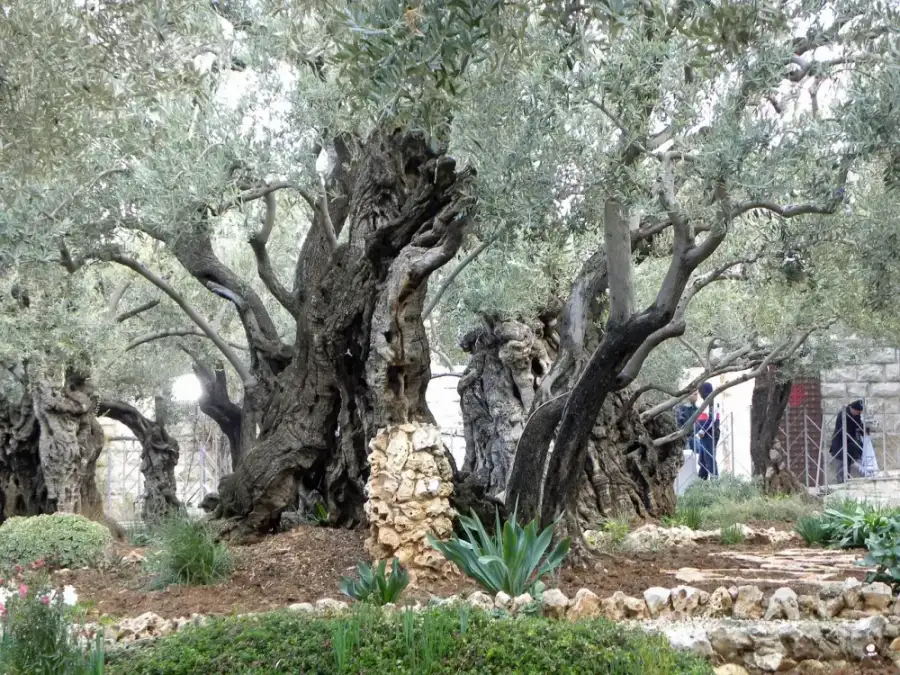
Most groups plan a sunrise visit when the garden is quiet and the Kidron is still in shadow. Open daily 8:00 to 17:00 (closes earlier in winter); the church dims lights and restricts movement during the noon liturgical hour, so arriving by mid-morning is worth the effort.
The Jewish cemetery
The western slope of the Mount of Olives holds approximately 150,000 graves, making it the oldest continuously used Jewish cemetery in the world. Burials have taken place here for roughly 3,000 years, with the earliest tombs dating to the First Temple period (around the 9th century BCE) and the latest being dug this week. The location is theological. Zechariah 14:4 describes the Lord’s feet standing on the Mount of Olives at the day of the Lord, and rabbinic tradition holds that resurrection will begin from this slope, with the dead rolling through underground tunnels to their places.
Notable graves include the prophets Haggai, Zechariah, and Malachi (by tradition, in the Tomb of the Prophets above); the 15th-century scholar Obadiah of Bertinoro; the Ohr HaChaim (Chaim ibn Attar, d. 1743); the founder of modern Hebrew Eliezer Ben-Yehuda (d. 1922); and Menachem Begin, the former Israeli prime minister (d. 1992), who asked to be buried here rather than in the national cemetery at Mount Herzl. The cemetery sustained extensive damage during Jordanian control from 1948 to 1967, when an estimated 38,000 gravestones were destroyed or used as construction material. Restoration has been ongoing since 1967.
Visitors are welcome. Modest dress applies, men should cover their heads, and flowers are not left on Jewish graves; the tradition is to place a small stone on the marker.
Tombs of the Kidron Valley
At the base of the slope, immediately below the Jewish cemetery, the Kidron Valley holds three prominent Second Temple period monumental tombs carved directly from the cliff face. The Tomb of Absalom is the most visible, a 20-meter conical structure with an Ionic facade dating to the 1st century CE (not, despite the name, to the 10th-century BCE son of David). Adjacent to it, the Tomb of Zechariah is a solid pyramid cut from the bedrock, also 1st century CE. Between them, the Tomb of Bnei Hezir preserves a Hebrew inscription naming it as the burial place of a priestly family, firmly dated to the late 2nd or early 1st century BCE.
The tombs are free to view from the path and can be reached from Gethsemane by walking south along the valley floor for about 400 meters. Interiors are not open to visitors.
The Palm Sunday route
The traditional Palm Sunday procession begins at Bethphage, a small village on the eastern slope of the Mount of Olives where Matthew 21:1-7 locates Jesus’s instruction to the disciples to find the colt. The Franciscan Church of Bethphage preserves a 12th-century Crusader stone marked with scenes traditionally identifying it as the mounting block. From Bethphage the route crosses the summit near the Chapel of the Ascension, descends past Pater Noster and Dominus Flevit (where Luke 19:41 places the weeping over the city), and ends at Gethsemane. The full walk is about 2.2 kilometers.
Latin Catholics hold the annual Palm Sunday procession along this route, beginning in the afternoon of the Sunday before Easter. The procession has been walked in some form since at least the 4th century, when Egeria described it in her pilgrimage diary. Joining it, if your visit coincides, is one of the more memorable experiences available on the ridge.
Practical visitor information
The Mount of Olives is reached by vehicle via Mount of Olives Road, which loops from the Jericho road (Route 417) around the ridge. Most tour buses drop groups at the summit near the Seven Arches viewpoint. The walk down to Gethsemane on foot is the standard approach and takes 30 to 60 minutes depending on site visits. Walking up is not recommended in summer heat; the slope averages a 14 percent grade.
Security on the ridge has improved substantially since the early 2000s, but travel in groups rather than alone, particularly below the Jewish cemetery in the Kidron Valley. Taxis from the summit back to the Old City are readily available.
Opening hours vary by site. The Franciscan sites (Dominus Flevit, Church of All Nations) follow a standard schedule of roughly 8:00 to 11:45 AM and 2:30 to 5:00 PM. The Chapel of the Ascension opens in the morning and closes in mid-afternoon. Pater Noster is closed Sundays. The Russian Church of Mary Magdalene has the most limited hours and should be checked in advance through the Russian Ecclesiastical Mission.
Dress code for all Christian sites on the ridge: shoulders and knees covered. The Jewish cemetery expects the same, with a head covering for men. Bring water; there are few vendors on the ridge itself, and the descent is exposed to sun.
For the broader context of where these sites fit into a Jerusalem itinerary, the Via Dolorosa station-by-station guide picks up where the Palm Sunday route ends, inside the Lions’ Gate. Groups building a complete Holy Week itinerary typically cover the Mount of Olives on the day before walking the Via Dolorosa, which matches the Gospel chronology from Palm Sunday through Good Friday.