This Basilica of the Annunciation Nazareth visitor guide covers the archaeological layers beneath the building, what is in the upper and lower churches, the denominational geography of the annunciation tradition, and the practical details that determine whether a group visit is rushed or rewarding. The basilica receives roughly two million visitors a year and reads very differently depending on how prepared the visitor is. Groups visiting Nazareth as part of a Holy Land pilgrimage can see how Day 4 of our Walk Where Jesus Walked 10-day tour covers the Basilica, the cliff at the Mount of Precipice, and Cana in a single Galilean day.
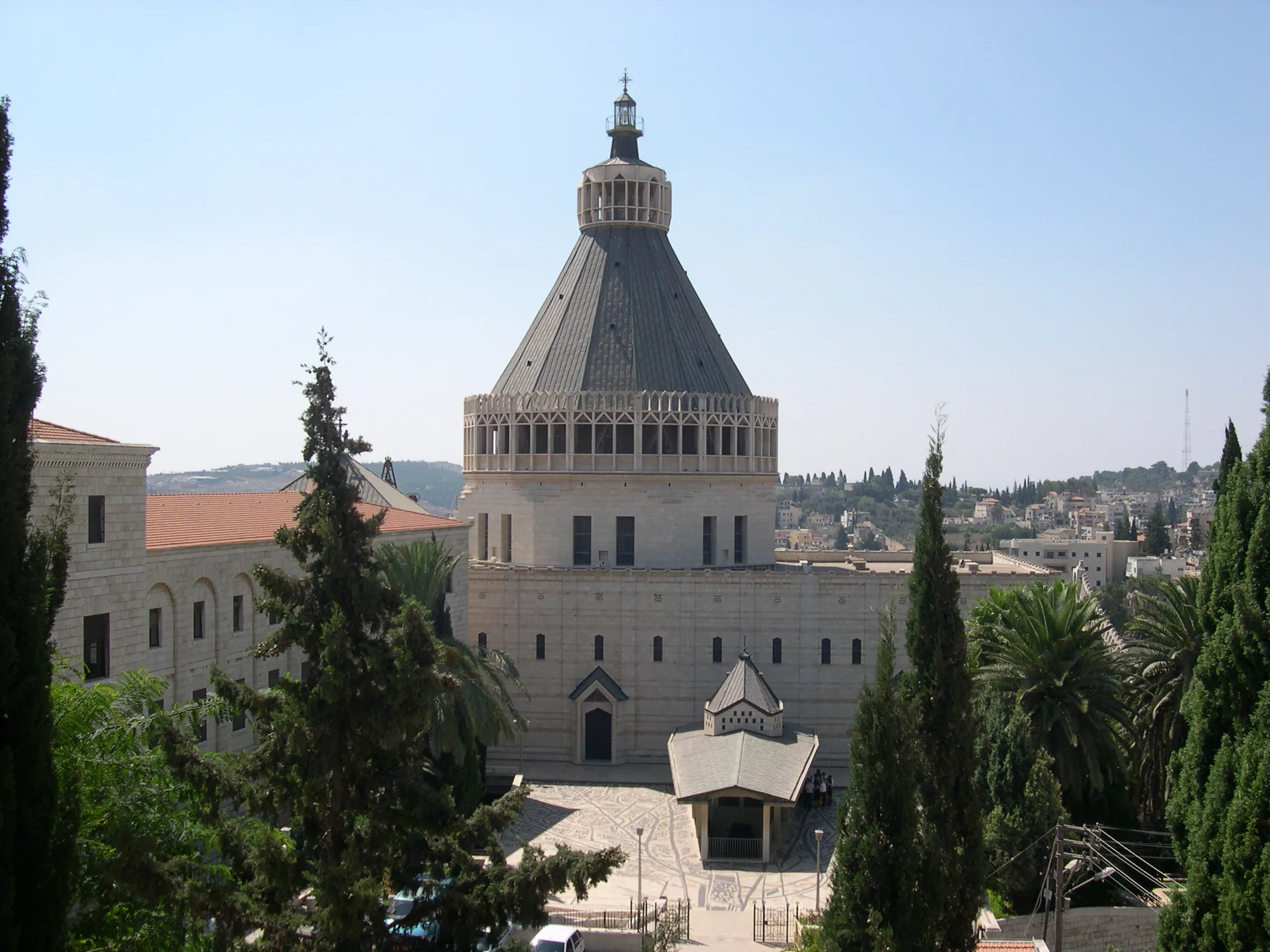
The Basilica of the Annunciation in central Nazareth is the largest Christian church in the Middle East. For Catholics it is the place where the angel Gabriel announced to Mary that she would bear Jesus, an event recorded in Luke 1:26-38. The current building was consecrated in 1969 and is the fifth church to occupy the site. The four that preceded it, layered beneath the current floor, are the reason the building looks the way it does.
Most first-time visitors expect a medieval church and are surprised to find a 20th-century concrete and stone basilica in a modernist Italian style. The architectural decision was deliberate. The architect, Giovanni Muzio, treated the surface church as a shelter for the archaeology rather than as a continuation of any earlier building. Walking through it without that context is disorienting. With it, the building makes sense.
The Grotto and the archaeological layers
The Grotto of the Annunciation is a small limestone cave in the lower church. Catholic tradition identifies it as the dwelling of Mary’s family. The cave itself is unremarkable as architecture: rough walls, a low ceiling, an altar in front of an iron screen with the Latin inscription “Verbum caro hic factum est,” “the Word was made flesh here.”
What surrounds the cave is the more substantial archaeological story. Excavations by the Italian Franciscan archaeologist Bellarmino Bagatti, conducted between 1955 and 1960 before construction of the current basilica began, exposed the remains of three earlier structures. The earliest is a small Jewish-Christian building from approximately the 3rd or 4th century, identified by Bagatti from architectural fragments and a series of inscribed plaster pieces. One fragment carries the Greek phrase XE MARIA, “Hail Mary,” among the earliest known Marian invocations in any context.
Above that layer Bagatti found the foundations of a Byzantine basilica from the mid-5th century, with mosaic floors partially intact. The pilgrim Egeria, traveling in the 380s, described visiting “a great and very splendid cave” in Nazareth where Mary had lived. Egeria’s account predates Bagatti’s Byzantine basilica, suggesting the cave was already a marked pilgrim site before the church was built around it. The Crusaders built a larger Romanesque church over the Byzantine remains in the 12th century, fragments of which are visible in the lower church today. After Saladin’s conquest of the region in 1187, the church fell into ruin. The Franciscans returned to Nazareth in the 17th century and built a smaller church on the site in 1730. That building stood until 1955, when it was demolished to permit excavation and construction of the current basilica.
The upper and lower churches
Muzio’s design separates the basilica into two functionally distinct levels.
The lower church surrounds and protects the Grotto. The space is intentionally dim, the ceiling kept relatively low, the focus drawn toward the cave itself. Around the perimeter are visible foundations of the Byzantine and Crusader churches, left exposed beneath glass and railings. A staircase descends to floor level for closer access to the Grotto altar. This is where most pilgrim groups celebrate Mass. Capacity is limited and group bookings are coordinated through the Franciscan custodians.
The upper church is a wholly different space. Tall, light-filled, with a hexagonal lantern dome rising above the Grotto directly below, it functions as the parish church for Nazareth’s Catholic community. Above the cave, an oculus in the floor allows visitors in the upper church to look down into the lower church and see the Grotto altar from above, a design choice that makes the architectural relationship between the two levels physically legible.
The upper church and the surrounding courtyards display the basilica’s most distinctive feature: more than 70 mosaic and ceramic panels of the Virgin Mary, donated by Catholic communities from around the world. The Japanese panel depicts Mary in a kimono surrounded by pearl divers. The Cameroonian panel shows her as a Black African woman. The American panel, a Cubist-influenced cast aluminum work donated in 1965, generated controversy at the time for its abstract style. Each donating country’s panel reflects its own iconographic tradition. The collection as a whole is the most extensive contemporary Marian art assembly in any single church, and walking the courtyards slowly is one of the more interesting experiences the site offers.
Catholic and Orthodox traditions of the Annunciation
Nazareth has two churches commemorating the Annunciation, in two different locations, reflecting two different textual traditions. Pilgrims often visit only one and leave assuming there is one site. There are two.
The Catholic basilica follows the canonical Gospel of Luke, which describes the angel Gabriel coming to Mary in her home. The home is identified with the Grotto.
The Greek Orthodox Church of St. Gabriel, about 600 meters north of the basilica, is built over a spring traditionally identified as the village’s ancient water source, now called Mary’s Well. The Orthodox tradition follows the Protoevangelium of James, a 2nd-century text not included in the canonical New Testament, in which Gabriel first speaks to Mary as she is drawing water at the well, and then a second time when she returns home. Orthodox tradition emphasizes the encounter at the well; the canonical encounter at home receives less iconographic weight.
The two traditions are not in formal conflict. Both communities acknowledge the other’s site, and the practical arrangement has held for centuries. Greek Orthodox pilgrims usually visit both sites with priority on St. Gabriel’s. Catholic pilgrims usually visit only the basilica. Protestant pilgrims tend to visit neither and prefer the open-air precincts at Nazareth Village or the synagogue church, where the textual focus is on the Gospel narrative rather than the location.
What the visit is actually like
The basilica is set in a walled compound off Al-Bishara Street in central Nazareth, a few minutes’ walk uphill from the souk. Entry is through a security check and a dress-code check at the gate. There is no admission fee.
Most groups enter through the courtyard, walk the mosaic panels, then enter the upper church for orientation, then descend to the lower church and the Grotto. The reverse order, lower church first, often works better for smaller groups because the Grotto is quieter early in the morning and tour buses tend to fill the lower level after 10:00 AM. Allow 60 to 90 minutes for a thorough visit. A rushed visit of 30 minutes is possible and is what most bus tours allocate, though it leaves little time for the mosaics or the archaeological remains around the Grotto perimeter.
The Franciscan custodians celebrate Mass in the lower church on a regular schedule, and pilgrim group Masses are bookable in advance, usually months ahead for peak season. Groups not celebrating Mass should avoid the scheduled liturgical times if their priority is access to the Grotto for prayer or photography.
Photography without flash is permitted throughout the basilica except during liturgies. Tripods and video equipment require permission from the custodians. Quiet is expected, particularly in the lower church.
Practical details and what most visitors miss
Hours are 8:00 AM to 6:00 PM Monday through Saturday, with Sunday access restricted to worshippers until after the main morning Mass. Hours change on Catholic feast days. The Feast of the Annunciation on March 25 brings extended liturgies, processions, and large pilgrim crowds; visiting on that day is meaningful for the liturgy but unworkable for a calm site visit.
Dress code: shoulders and knees covered for both men and women. This is enforced.
Two things most first-time visitors miss. First, the small museum in the compound, off the southern courtyard, displays artifacts from Bagatti’s excavations including the inscribed plaster fragments and a model of the successive churches. The museum is free and rarely crowded. Most tour groups skip it. It is the best single explanation of what is beneath the basilica floor.
Second, the Church of St. Joseph, a smaller Franciscan church about 100 meters north of the basilica within the same compound, is built over a separate cave traditionally identified as Joseph’s carpentry workshop. The current building dates from 1914 and sits on Crusader and Byzantine foundations also documented by Bagatti. The crypt is accessible by a staircase from the church floor. Most basilica visits do not include St. Joseph’s. They should.
For pilgrims building a Galilee itinerary, Nazareth pairs naturally with the lakeside sites covered in the Sea of Galilee complete guide, about 30 kilometers east. A full day in Nazareth, including the basilica, the synagogue church, and the other sites worth visiting in town, can be combined with a half day at Capernaum and the Mount of Beatitudes the following morning. For the broader archaeological context of Nazareth’s 1st-century identity, see Where Jesus walked: archaeology at 10 key sites.