You hear the lake before you see it.
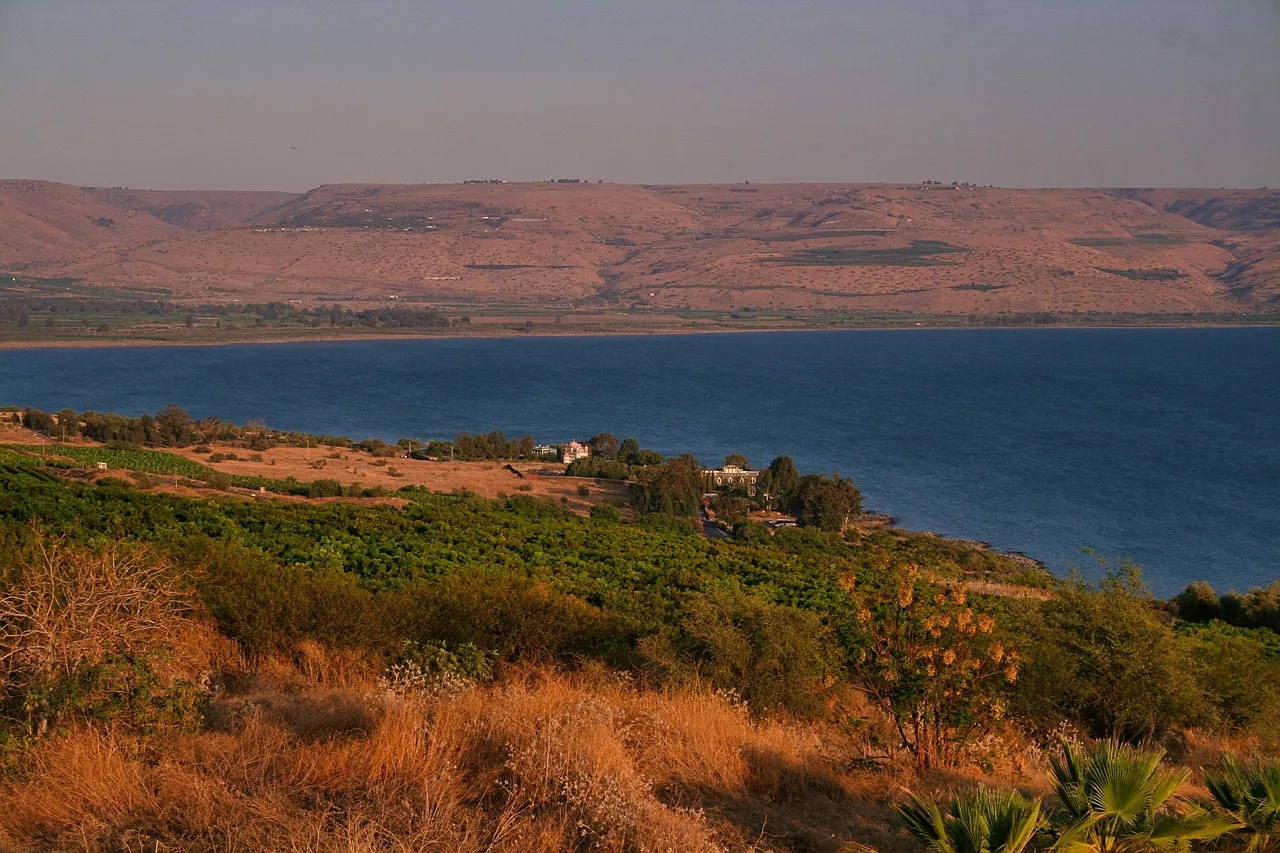
The bus drops your group at the parking lot of the Mount of Beatitudes, and as you walk through the gate into the gardens, the first thing that reaches you is the breeze coming up off the water and a low hum from the slopes below: cicadas, doves, a tractor somewhere on the road to Capernaum. Then the path turns, the trees open, and the Sea of Galilee is there. Not at a distance. Right below you, a sheet of pale blue spread between green hills, with Capernaum on the shore at the foot of this hill and the Golan rising on the far side.
This is the slope where Matthew places the Sermon on the Mount: “Now when Jesus saw the crowds, he went up on a mountainside and sat down. His disciples came to him, and he began to teach them” (Matthew 5:1-2). What followed is three chapters of Matthew, the longest single block of Jesus’s teaching in any Gospel. The Beatitudes, the salt and light, the Lord’s Prayer, the lilies of the field, the wise and foolish builders. Most of what people quote when they quote Jesus comes from this hillside.
The Mount of Beatitudes is one stop on most Sea of Galilee itineraries, usually paired with Tabgha and Capernaum on the same morning. The three sites sit within a few kilometers of each other and tell one continuous story: where Jesus taught, where he fed the crowd, where he lived. Groups building a full Gospel-geography itinerary around these sites can see how Galilee is sequenced within the Walk Where Jesus Walked 10-day tour, which devotes two days to the northwestern shore before continuing south to Jerusalem.
The Sermon on the Mount and what pilgrims read here
The Beatitudes themselves are eight short blessings that open the sermon: “Blessed are the poor in spirit, for theirs is the kingdom of heaven. Blessed are those who mourn, for they will be comforted” (Matthew 5:3-4). They go on through the meek, the hungry for righteousness, the merciful, the pure in heart, the peacemakers, and those persecuted for righteousness’s sake.
Most groups read the eight verses out loud once they have settled in the gardens. Some read all of Matthew 5 through 7. The reading takes about fifteen minutes if you take it at a normal pace, longer if you stop after each beatitude and let it sit. There is no wrong way to do it. The text was preached on this slope. Hearing it read here is one of the closest things a pilgrim can do to time travel.
If your group has a hymnal or a guitar, “Blest Are They” or a simple setting of the Lord’s Prayer in the place where Jesus taught it carries differently than it does in a sanctuary at home.
The hillside and its acoustics
The hill is not high. The summit sits about 60 meters above the lake, and the slope down to the shore is gentle, terraced in places, planted with grass and olives. From above it forms a natural amphitheater opening south toward the water.
Acoustic studies done on this hillside in the 1970s and again in the 2000s confirmed what the early pilgrims already knew: a single voice speaking from a position partway up the slope carries clearly to listeners sitting on the terraces below. The lake surface reflects sound. The hills on either side hold it. A teacher with a strong voice could address several thousand people on this slope without strain. Matthew 5:1 says Jesus went up the mountainside and sat down. The seated posture was the standard teaching position of a Jewish rabbi. He didn’t need to shout. The hill did the work.
You can test this yourself. Walk down twenty meters into the gardens, ask someone in your group to stand higher up the slope and read Matthew 5:3 in a normal voice, and listen. The sound arrives clean.
The octagonal church by Antonio Barluzzi
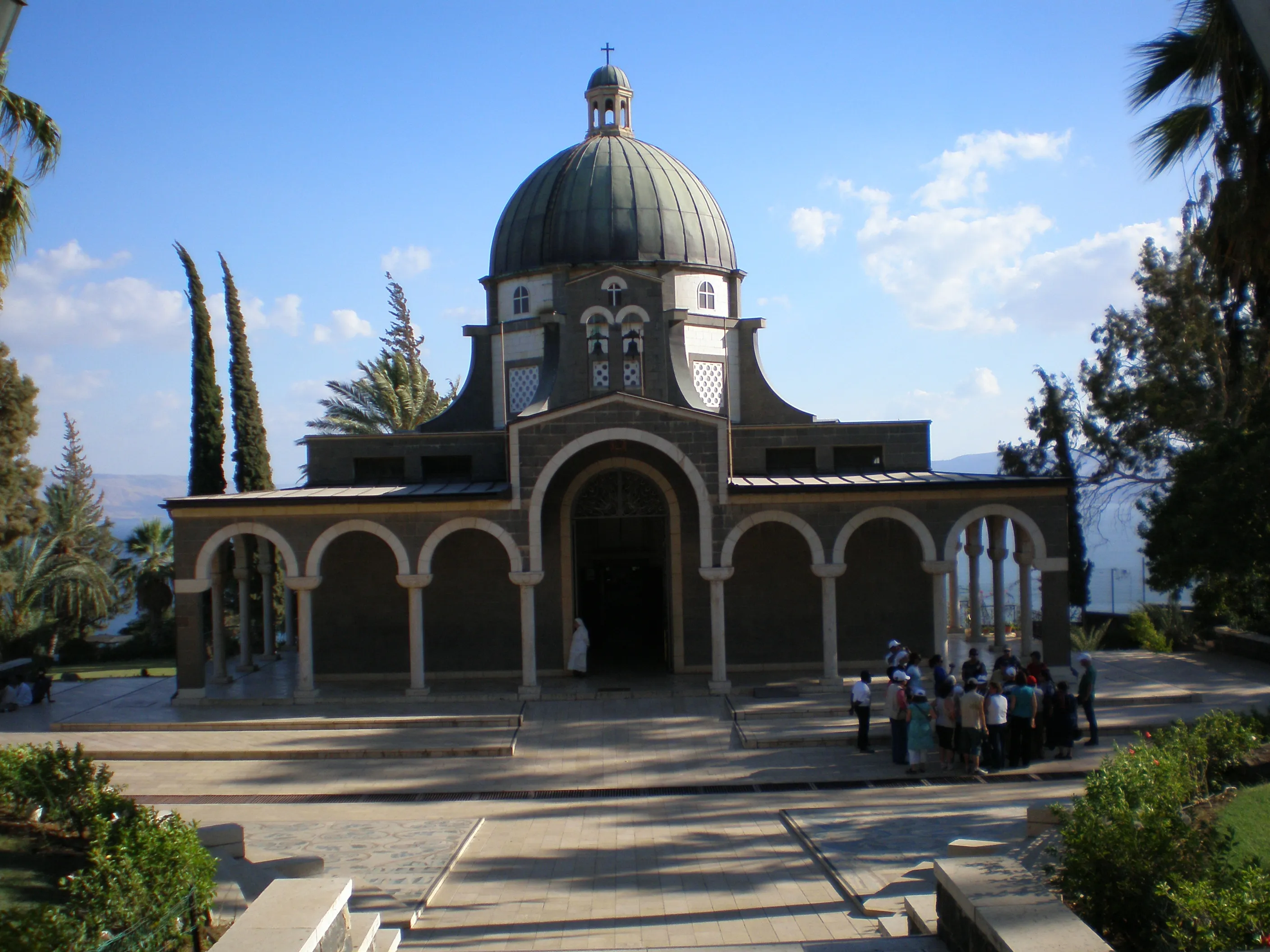
The church on the summit is the work of Antonio Barluzzi, the Italian Franciscan architect who designed many of the 20th-century pilgrimage churches across the Holy Land: the Church of All Nations at Gethsemane, Dominus Flevit on the Mount of Olives, the Chapel of the Angels at the Shepherds’ Field. Barluzzi built this one in 1937-1938 for the Franciscan Custody of the Holy Land, on commission from the Italian Catholic Action.
The plan is octagonal. Eight sides for the eight Beatitudes. The church is small, low to the ground, with a central dome supported by columns of black basalt that match the dark stone scattered across this part of Galilee. A covered ambulatory wraps the exterior, so pilgrims can walk all the way around the building under shade, looking out toward the lake from each of the eight angles.
Inside, the eight Beatitudes are inscribed in Latin in the windows of the dome, one per panel. The floor is marble, with seven virtues set in mosaic around the central altar: justice, prudence, fortitude, temperance, faith, hope, and charity. The lighting is low. The dome catches whatever sound rises from the floor and returns it softly. Groups that sing inside the church often pause after the first phrase, because the building does something with the sound that surprises them.
The church holds about 100 people seated. For larger groups, the worship moves outside.
The gardens and the Franciscan sisters
The compound is run by the Franciscan Missionary Sisters of the Sacred Heart, who have maintained the site since the church was completed. They live in a small convent and guesthouse on the property, run a kiosk near the gate, and keep the gardens. The gardens are the reason most pilgrims remember the visit as much as the church.
Paths wind down the slope through bougainvillea, oleander, palms, and old olive trees. Stone benches sit at intervals along the way, each one positioned with a view down to the lake. Several covered open-air chapels are built into the slope for groups to use. The Sisters allow Catholic Masses at the outdoor stations and welcome Protestant and evangelical groups to read Scripture and sing in the same spaces. There is a quiet flow of groups through the gardens most mornings, each finding their own bench, their own view, their own ten minutes with the text.
The guesthouse run by the Sisters has about 60 beds and is a popular overnight option for groups who want to wake up on the hillside and read the Beatitudes at sunrise. If your itinerary allows it, the morning light over the lake from this slope is one of the things pilgrims talk about for the rest of the trip.
Visiting practicalities
The site is open daily, generally 8:00 AM to 11:45 AM and 2:30 PM to 4:45 PM, with the midday closure for the Sisters’ lunch and prayer. There is a small parking fee for vehicles. There is no entrance fee for the gardens or the church, though donations to the Sisters are welcomed.
Dress code follows the standard for a Catholic pilgrimage church: shoulders and knees covered for men and women. Scarves are sometimes available at the entrance for visitors who arrive unprepared. Inside the church, silence is requested. Outside in the gardens, normal conversation and group readings are fine.
The site is a 12-kilometer drive from Tiberias and roughly 3 kilometers from Capernaum and Tabgha by road. Tour groups typically combine all three on the same morning, with the Mount of Beatitudes either first (for the Sermon read at the start of the day) or last (as the contemplative close after the lake and Capernaum).
Wear closed shoes with grip. The garden paths are paved but slope steeply in places, and the grass terraces near the lower benches can be slippery in dew. Bring a hat and water in summer. Shade is plentiful but not continuous.
Why pilgrims linger here
Most Holy Land sites carry a heavy weight of stone and centuries: the layered churches, the worn floors, the queues for an edicule. The Mount of Beatitudes is light by comparison. The church is small. The gardens are open. The view is the main thing. For the wider archaeological picture of Galilean ministry, see Where Jesus walked: archaeology at 10 key sites.
What pilgrims remember is sitting on a bench under an olive tree, reading the Beatitudes out loud to themselves or with two or three others, and looking down at the same water Jesus would have looked at while he taught. The hill is the same hill. The lake is the same lake. The wind off the water in the late afternoon does the same thing it has always done.
“Blessed are the pure in heart, for they will see God” (Matthew 5:8). You read it on the hillside where it was first spoken, and the line lands a little differently than it did at home.